

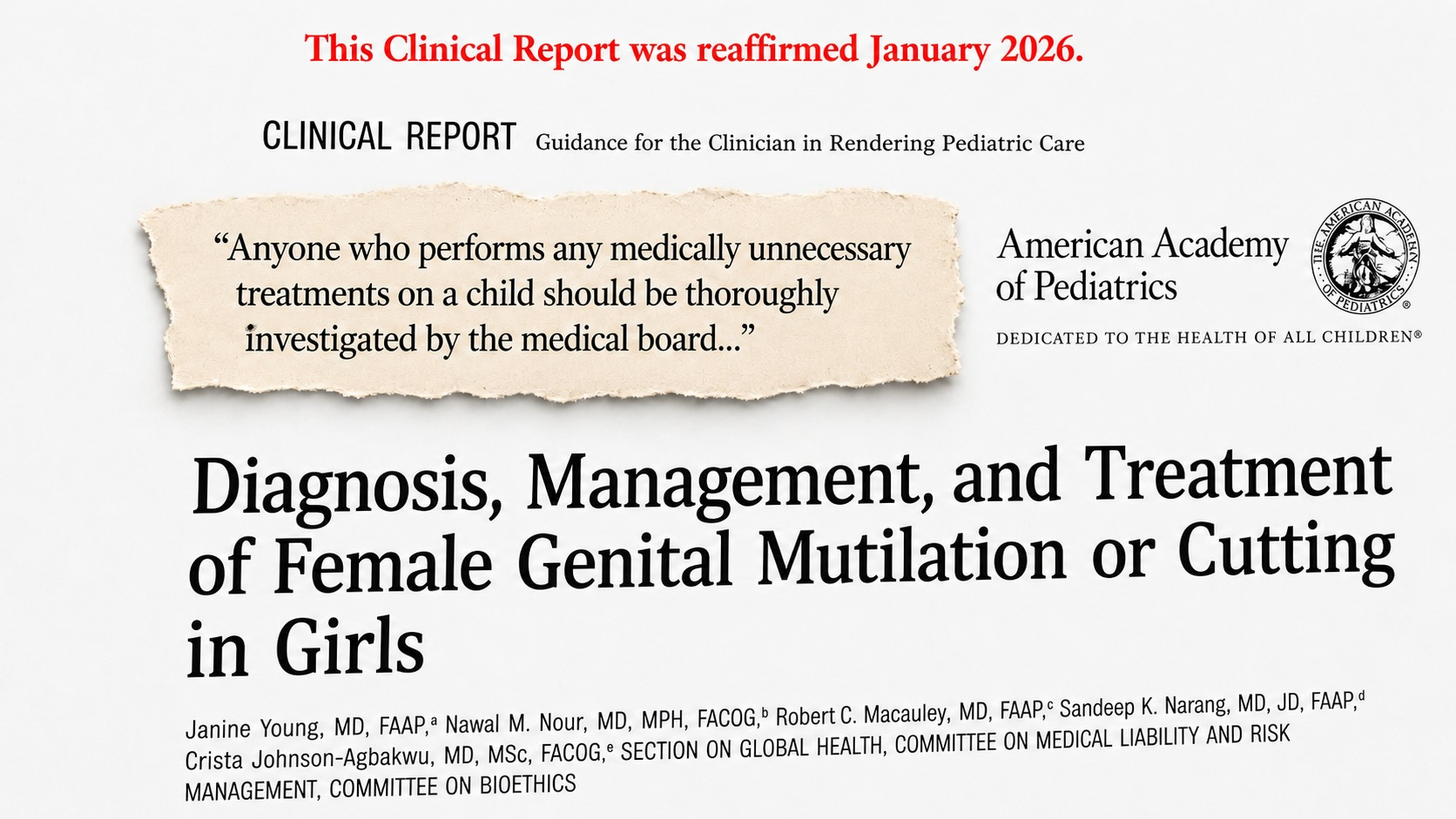
In an email on July 29, Dr. Janine Young, the lead author of the American Academy of Pediatrics’ clinical standard on female genital mutilation, stated that “anyone who performs any medically unnecessary treatments on a child” should be thoroughly investigated by the medical board. She did not limit the statement to FGM.
Asked what determines whether a procedure is medically unnecessary, she said, “I assume that this would be determined by the medical board of each state.” Michigan’s state medical board investigated the physicians charged in America’s first federal FGM prosecution and closed the investigation with no action.

Dr. Janine Young is a Professor of Pediatrics at UC San Diego, Division Chief of Academic General Pediatrics, Developmental-Behavioral Pediatrics and Newborn Medicine, and the Martin T. Stein Endowed Chair in Developmental-Behavioral Pediatrics. She is the lead author of “Diagnosis, Management, and Treatment of Female Genital Mutilation or Cutting in Girls,” published in Pediatrics in August 2020 and reaffirmed in January 2026. It is the AAP’s only clinical standard on FGM in children.
I contacted the AAP in June about the continued licensing of two physicians charged in United States v. Nagarwala, America’s first federal FGM prosecution. Dr. Jumana Nagarwala (License No. 4301071795) and Dr. Fakhruddin Attar (License No. 4301067384) hold active, unrestricted Michigan medical licenses today. The state investigations into their licenses were closed before the federal court ruling. Neither physician was convicted. The federal district court held the FGM statute unconstitutional in 2018, and the case was dismissed in 2021.
The AAP responded by sending Young’s clinical report. It did not answer any questions about whether these physicians should retain their licenses.
Nicole Warren, an Associate Professor at Johns Hopkins University School of Nursing and Women’s Health Director at the HEAL Refugee Health and Asylum Cooperative, referred me to Young as the report’s author. Warren described Young as having “wrote the AAP guidelines” and suggested she “may have input.”
I contacted Young on July 28, identified myself as a journalist, provided the case context, noted the AAP’s non-response, and asked three questions.
Was she aware that both physicians hold active, unrestricted licenses?
“No, I was not aware of this.”
Does the report contemplate what should happen to a provider’s license when they perform FGM on children?
“In my personal opinion as a pediatrician and lead author of the AAP report, I believe that anyone who performs any medically unnecessary treatments on a child should be thoroughly investigated by the medical board in that state and that the state should follow a structured disciplinary process.”
Young framed the answer as her personal opinion, separating herself from the AAP as an institution. The question asked about FGM. Her answer referred to “any medically unnecessary treatments.”
Did the 2026 reaffirmation involve any review of this case?
“I was not involved in the reaffirmation process so I do not know the answer to that question.”
On August 10, I asked Young what determines whether a procedure is medically unnecessary. She replied the same day:
“I assume that this would be determined by the medical board of each state. So, if I saw a patient who had FGC performed and they or guardian told me that the Fgc was done by X doctor in X state, I would immediately report that doctor to the medical board.”
Young’s report defines FGM/C as involving “medically unnecessary cutting of parts or all of the external female genitalia.” The report uses the term as its definitional boundary. Asked who determines what that term means, the lead author said state medical boards.
Michigan’s Bureau of Professional Licensing opened an investigation into Nagarwala’s medical license. It closed investigation 43-XX-146153 on September 25, 2018, with no disciplinary action. It opened an investigation into Attar’s license. It closed investigation 43-XX-146259 on July 27, 2018, with no disciplinary action. Both physicians hold active, unrestricted licenses today.
The Federation of State Medical Boards, the national organization representing every state medical board in the country, declined to condemn licensing physicians who performed genital cutting on children. The AMA condemned FGM in the abstract but deferred to the FSMB on licensing. The AAP sent Young's report. Across eleven medical organizations and professional bodies contacted for this investigation, none said that female genital cutting on children should cost a physician their medical license. Young is the first person in any of these organizations to state, in writing, that physicians who perform medically unnecessary procedures on children should face investigation and a structured disciplinary process.
On August 13, I asked a follow-up: “You said the determination of medical necessity would be made by the medical board of each state. Does that mean it is up to each state medical board to determine what medical procedures are and aren’t necessary?” She did not reply.
The report is twenty-six pages. It covers CPS reporting requirements, criminal statutes, asylum law, ICD-10 coding, defibulation procedures, community engagement strategies, vaccination protocols, mental health referrals, and detailed case examples. It discusses the Nagarwala prosecution by name, noting the Department of Justice “prosecuted its first case against a US physician accused of having performed FGM/C across state lines in up to 100 children” and that “the charges were dismissed by the district judge of the Eastern District of Michigan.”
The report does not contain the word “license” or discuss what should happen to the performing physician’s credential. Every enforcement mechanism it names runs through criminal law, child protection, or immigration. None addresses the medical licensing board.
In her email, Young stated that physicians who perform medically unnecessary procedures on children should be investigated and disciplined by the state medical board. The report does not say this. Asked what determines medical necessity, she said the state medical board determines it. A state medical board investigated and closed with no action.
Multiple national medical associations, including the Royal Dutch Medical Association, the Danish Medical Association, the British Medical Association, and the Canadian Paediatric Society, have stated that routine circumcision of male children is not medically necessary. The AAP’s own 2012 policy on circumcision, which found benefits outweigh risks, expired in 2017 without reaffirmation. The AAP currently has no active policy position on whether circumcision is medically necessary. The author of their FGM policy statement says that doctors should be "thoroughly investigated" and that the “state should follow a structured disciplinary process” for “medically unnecessary treatments on a child.”
The AAP’s own World Health Organization classification table, reproduced in Young’s report, categorizes FGM into four types and subtypes. Type Ia is defined as “removal of prepuce only.”
If you’d like to support this work, you can contribute here: Expose Medical Board for Licensing an FGM Doctor.
Thank you, Brendon, for holding these slippery bureaucrats accountable. And for continuing to report on this important issue, of protecting all children from medical assault.