

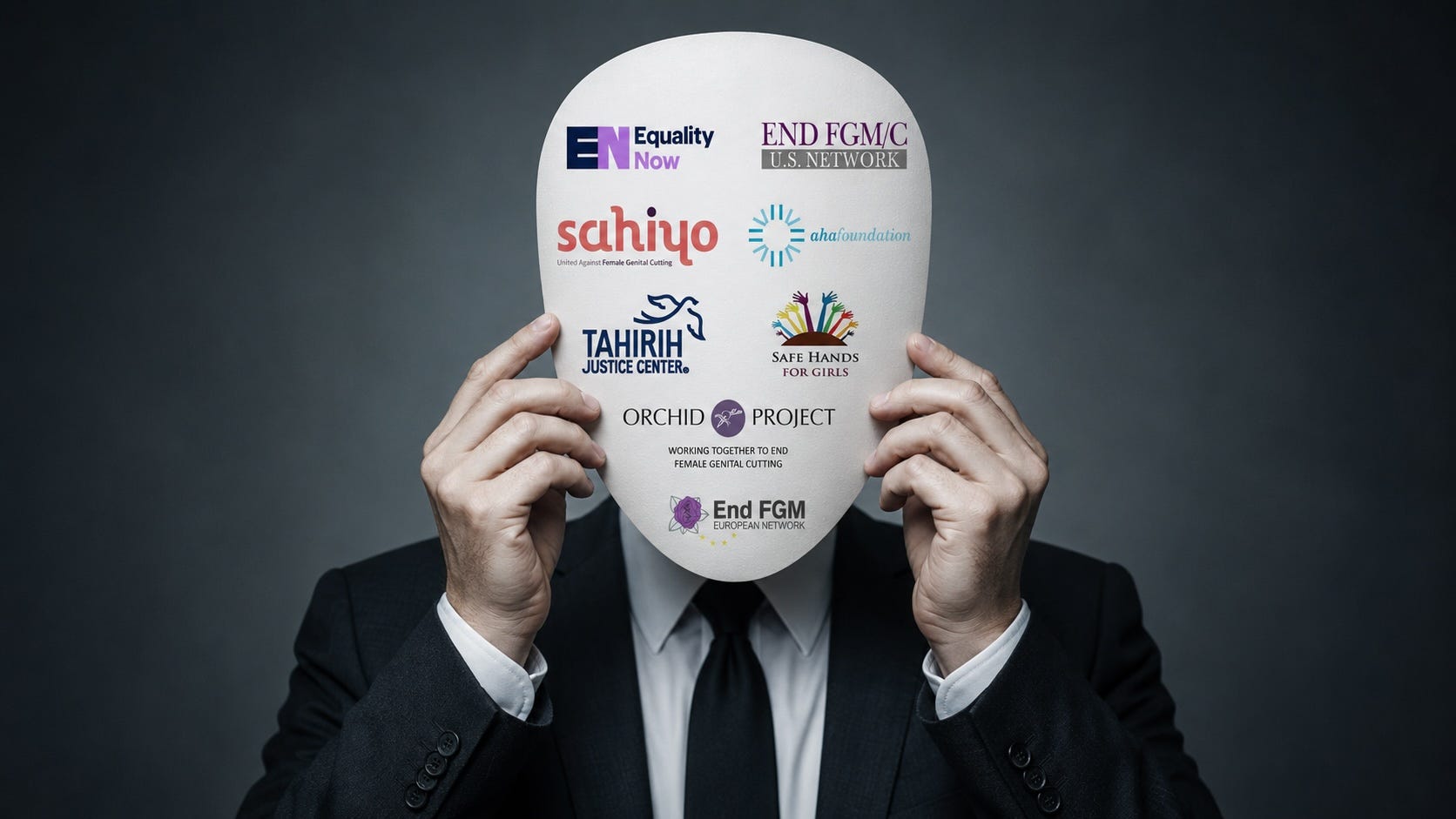
Anti-FGM organizations receive government funding. They act when activism means supporting government prosecution. They are silent when it means criticizing the government. Is the anti-FGM movement a government sock-puppet?
Context
Dr. Jumana Nagarwala and Dr. Fakhruddin Attar were charged in the first federal FGM prosecution in U.S. history. The district court dismissed the FGM counts and held the federal statute unconstitutional in November 2018. Despite the FGM being undisputed, neither physician was convicted.
My original reporting revealed that Michigan's Bureau of Professional Licensing closed investigations into both licenses before the federal prosecution ended. Despite their involvement in FGM, both hold active Michigan medical licenses with no disciplinary action on their public records. Michigan's Bureau of Professional Licensing lied to the press about its investigation, dismissed physician complaints, and renewed Nagarwala's medical license during my investigation. It has refused to tell the public why the doctors are still licensed. Memos explaining why their case was closed have been withheld from the public.
How did anti-FGM organizations respond to the continued licensing of FGM doctors?
They did nothing.
Anti-FGM Intaction
As I previously reported:
I asked eight organizations that work to end female genital mutilation whether two physicians charged in America’s first federal FGM prosecution should continue to hold active medical licenses. Six did not respond. One responded, but did not answer the questions. One initially took a position that meant that FGM doctors should keep their licenses, and had to be told to read the reporting they were responding to before they gave a new comment.
None showed they were aware the FGM doctors were still licensed. Why?
Case Involvement
Anti-FGM organizations were actively involved in the Nagarwala case:
AHA Foundation claims it connected the original whistleblower to federal law enforcement. It filed its own amicus brief through White & Case on September 24, 2018. Amanda Parker testified before the Michigan House Committee on Law and Justice in May 2017 and helped develop Michigan’s state FGM legislation. AHA says it worked with members of both parties on the revised federal ban signed in January 2021.
Equality Now was the lead organization on a joint amicus brief filed September 24, 2018 with Sahiyo, Safe Hands for Girls, and WeSpeakOut. Shelby Quast gave media commentary after Nagarwala’s arrest and wrote two case-centered essays for Ms. magazine.
Sahiyo was a named party on the joint amicus brief. Sahiyo organized a roundtable with the Michigan Department of Health and Human Services on October 9, 2017 and later produced a podcast episode on the prosecution’s effect on Bohra survivors.
Safe Hands for Girls was a named party on the joint amicus brief. Founder Jaha Dukureh gave media commentary throughout the prosecution.
U.S. End FGM/C Network claims it joined the amicus brief, but the filed document does not list the Network in its caption or signature block. The Network sent a letter to Speaker Pelosi on September 10, 2020 urging passage of the STOP FGM Act and issued a statement after the final dismissal in 2021.
Tahirih Justice Center participated in an October 2017 Michigan DHHS roundtable on the case with Sahiyo and Equality Now.
Orchid Project published a response to the constitutional ruling on November 21, 2018.
End FGM European Network issued a press release the day after the ruling.
Given that these organizations were aware of the case, why were they not tracking the medical licensing? Did they just lack the resources?
No. The anti-FGM movement is a multimillion dollar operation.
Significant Resources
Anti-FGM organizations have significant resources:
Equality Now reported $12,083,779 in revenue and $27,682,465 in net assets in its 2024 Form 990. It also operates a U.K. entity that reported £2.91 million in income.
Tahirih Justice Center reported $11,920,808 in revenue in its 2024 Form 990 and $10,151,038 in net assets. Its 2025 audit shows an additional $29,241,898 in donated professional services.
AHA Foundation reported $1,187,403 in revenue in 2024. It spent $593,000 on FGM legislative advocacy and support, roughly 45.5% of all expenses.
Orchid Project reported £957,920 in income for the year ending March 2025.
Safe Hands for Girls reported $877,303 in revenue in 2024.
End FGM European Network reported €684,048 in revenue in 2024.
Sahiyo reported a $576,444 operating budget for 2023-24.
U.S. End FGM/C Network does not file its own Form 990. It operates through fiscal sponsorship by Reading Room Cleveland, Inc. and does not publicly disclose its budget.
Lack of awareness or involvement in the medical licensing case can’t be explained by lack of resources. These organizations had the budget.
But where does that money come from?
The government.
Government Funding
Most anti-FGM organizations are government funded.
End FGM European Network receives approximately 96% of its revenue from the European Commission or EU-cofunded projects, roughly €656,686 in 2024.
Sahiyo reported 60.3% of its operating budget as government grants, approximately $347,596. Its government funders include the DOJ Office on Violence Against Women, HHS Administration for Children and Families, and Washington State Department of Health.
Tahirih Justice Center reported $5,552,673 in government grants in its 2024 Form 990, approximately 46.6% of revenue. Its 2025 federal expenditure schedule lists $2,638,741 from the Departments of Justice, HHS, Labor, and Treasury.
AHA Foundation reported $38,000 in government grants in 2024, approximately 3.2% of revenue. It also holds a separate $500,000 DOJ Office on Violence Against Women award for a 36-month FGM prevention project.
Orchid Project is a funded participant in a U.K. Foreign, Commonwealth and Development Office program on ending FGM. Its individual share is not publicly disclosed.
U.S. End FGM/C Network is a DOJ Office for Victims of Crime technical-assistance provider and participates in a $300,000 DOJ cooperative agreement and a Washington State contract. Its individual shares and total budget are not disclosed.
Equality Now reported $500,000 in government grants in 2021 and appears in EU grant records.
What do these organizations do with all that money they get from the government?
They send it back to the government in the form of lobbying and services.
Government Lobbying and Services
The primary activism of many anti-FGM organizations is lobbying the government and fulfilling government contracts.
AHA Foundation spent $593,000 on “FGM legislative advocacy and support” in 2024, approximately 45.5% of all expenses that year. Its Form 990 states AHA worked closely with legislators in Washington, D.C.
Tahirih Justice Center reported $33,129 in statutory lobbying in 2024, up from $14,870 in 2021. Its broader advocacy spending was $1,873,463 in 2024. Tahirih’s auditors state the organization holds cost-reimbursable grants and contracts with U.S. government and state agencies.
Equality Now reported $67,602 in statutory lobbying in 2023 and $0 in 2024. Its program descriptions include training law-enforcement officials, prosecutors, and judges. Through the SOAWR coalition, Equality Now trains government officials and submitted 78 legal submissions to governmental bodies in 2024.
End FGM European Network declared “no lobbying costs” on its EU transparency register while spending approximately €394,524 on “core activities” that include advocacy, communications, and governance. In 2024, the Network secured signatures from 144 European election candidates, 20 of whom became MEPs, and sent policy requests to incoming Commissioners.
Sahiyo holds government contracts to implement Washington State’s FGM law and participates in a $300,000 DOJ cooperative agreement to provide training and technical assistance. Its program spending includes work with government officials to build systems of care.
U.S. End FGM/C Network is a DOJ Office for Victims of Crime technical-assistance provider, participates in the same $300,000 DOJ cooperative agreement as Sahiyo, and holds a Washington State Department of Health contract with Sahiyo and Mother Africa. The Network describes its work as advocating for state FGM laws, strengthening the federal FGM law, and seeking increased government funding.
Safe Hands for Girls trained Gambian prosecutors and Child Welfare Officers on investigating and prosecuting FGM. Its Form 990 describes sponsoring lawmakers’ visits to Egypt and engagement with governments and UN bodies to shape policy.
Orchid Project holds responsibility for global advocacy within a U.K. FCDO-funded consortium and submits evidence to U.K. parliamentary inquiries on government policy toward FGM.
If we follow the money, these are not independent “grassroots” organizations. They receive money from the government, and in turn, serve the government and lobby for its preferred policies.
There is a name for this arrangement: sock puppets.
Sock Puppets
The 2012 paper Sock Puppets: How the Government Lobbies Itself and Why by Christopher Snowdon at the Institute of Economic Affairs defines sock-puppet organizations as state-funded pressure groups that “masquerade as civil society while promoting the ideology of the political elite.”
These organizations create “the illusion of grassroots support for new legislation” by appearing to be independent, instead of “government lobbying government.” If these organizations were funded by an industry, “we would call them front groups.”
The anti-FGM movement in the United States fits this model. Government money flows to these organizations, which they then use to lobby for the laws that support government prosecutions, to train the government officials to enforce those laws, and to seek more government funding. The money flows in a circle.
Snowdon is careful to note that this does not mean activists involved in sock-puppet organizations are not sincere or that their cause does not have merit. However, sock-puppet organizations create several issues, one of which is that those organizations lose any independent voice they once had, and “speak loudly when it agrees with its funders, but fall silent when it does not.”
Anti-FGM organizations’ actions align to government incentives:
Anti-FGM organizations were loud when it meant supporting the government. Eight organizations filed amicus briefs, testified before state legislatures, gave media commentary, organized government roundtables, and lobbied Congress. All aligned with the Department of Justice's prosecution.
Anti-FGM organizations went silent when it meant criticizing the government. When I asked all eight whether FGM doctors should continue to hold active medical licenses, six did not respond, one responded without answering the questions, and one had to be told to read the reporting before it revised its position. None knew the doctors were still licensed.
Even though there is no direct link between government funding and anti-FGM organization inaction, Snowdon’s model doesn’t require one. Incentives alone are enough to explain their behavior.
Supporting a federal prosecution aligned with the government. Criticizing a state licensing board's decision did not. So they did one, but not the other.
Grassroots Activism
One of the costs of sock-puppets is that they crowd out genuine independent voices by forcing them to compete against millions in public money with only their own resources.
The anti-FGM movement has tens of millions of dollars in annual revenue. The organizations in this article receive government grants, hold government contracts, and spend money lobbying the government. They did nothing to investigate the medical licensing of FGM doctors.
I am an independent journalist spending my own money. I did all of the research in this investigation in my spare time. I do not have government grants. I have a GoFundMe. I broke the story that they were still licensed. This is what actual grassroots look like. This is what a genuine anti-FGM movement would support.
When I reached out to the eight anti-FGM organizations mentioned, they did not pursue action that would put them in conflict with a government agency, instead of profiting from one. Their response is consistent with the behavior of sock-puppet organizations.
If you’d like to support my work, you can contribute to my GoFundMe here.
Stellar research, Brendon. Thank you, for your commitment to revealing the truth, and exposing the corruption and fraud.