

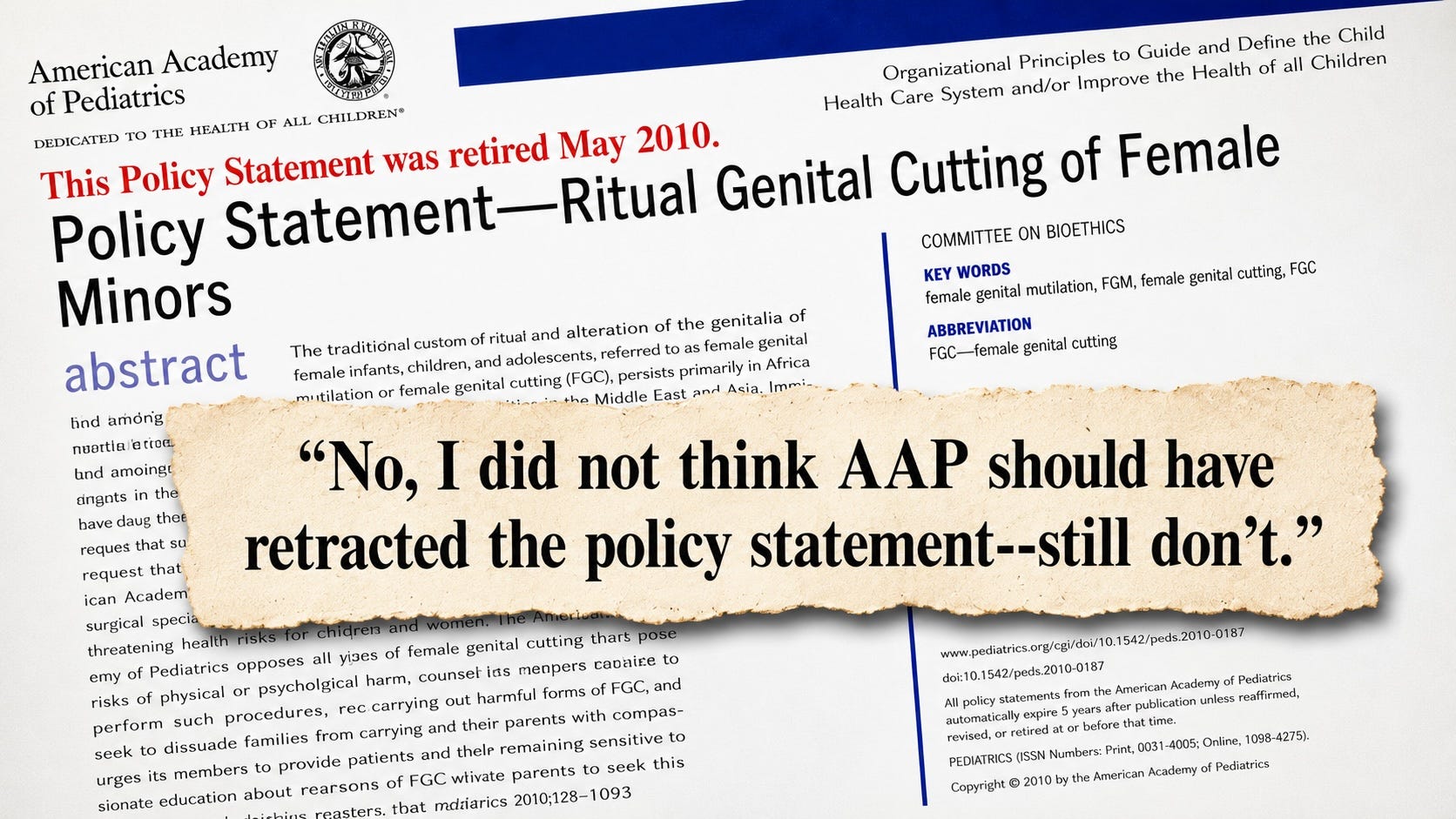
Dena S. Davis, the lead author of the American Academy of Pediatrics’ (AAP) retracted 2010 ‘ritual nick’ policy on female genital cutting, told me in an email on June 19, 2026 that she does not believe the AAP should have retracted it.
“No, I did not think AAP should have retracted the policy statement,” Davis wrote. “Still don’t.”

The 2010 policy recommended that physicians be permitted to perform a “ritual nick” on girls’ genitals. The AAP retracted the recommendation within weeks after public outcry. What has not been reported until now is that the lead author who wrote the policy never changed her mind. Davis stands behind the recommendation sixteen years later.
In 2001, Davis published “Male and Female Genital Alteration: A Collision Course with the Law?” in Health Matrix at Case Western Reserve. She argued that the federal law criminalizing all genital alteration on female minors was constitutionally vulnerable because it banned procedures on girls “no matter how minimal the surgery or how safe and sanitary the procedure,” while leaving male circumcision untouched. Once female genital alteration was understood to include a hygienic “ritual nick,” Davis wrote, the two practices “lack a legally defensible distinction.”
The article called out the double standard directly: “What this boils down to is, if you are an American Jew, you can have your baby boy genitally altered with impunity, even if it is done outside a hospital by an unlicensed ritual practitioner, and without the analgesia deemed ‘essential’ by the AAP. But if you are recent immigrant from Somalia, even if you would take the enlightened route and subject your daughter to a ritual nick at the Seattle clinic, you (and the doctor) would be subject to criminal prosecution. This is unacceptable on First Amendment grounds.”
Her recommendation: “Federal and state laws should be rewritten to allow the sort of minor genital nick.”
Nine years later, the AAP’s Committee on Bioethics adopted that position. The committee, chaired by Douglas Diekema of Seattle Children’s Hospital, published a policy statement concluding that “the ritual nick suggested by some pediatricians is not physically harmful and is much less extensive than routine newborn male genital cutting.” The statement lists Davis as “Consultant” with an asterisk denoting her as lead author and cites her 2001 law review article.
The statement suggested that the AAP “opposes all forms of FGC that pose risks of physical or psychological harm” but that “pricking or incising the clitoral skin… is no more of an alteration than ear piercing.” The conditional phrasing — “that pose risks” — created space for forms of genital cutting the committee judged not to pose such risks.
Anti-FGM organizations condemned the recommendation. Equality Now Executive Director Taina Bien-Aimé told The Lancet the statement “defies decades of extremely hard work” to eradicate female genital mutilation. On May 22, 2010, twenty-six days after publication, the AAP’s Board of Directors voted to retire the policy. In a new statement published in July, the AAP wrote: “The AAP does not endorse the practice of offering a ‘clitoral nick.’ This minimal pinprick is forbidden under federal law and the AAP does not recommend it to its members.”
In April 2017, the FBI charged Dr. Jumana Nagarwala in the first federal prosecution under the United States’ female genital mutilation statute. Dr. Fakhruddin Attar, who owned the Livonia, Michigan clinic where the procedures were performed, was also charged.
At Nagarwala’s detention hearing, defense counsel Shannon Smith described the procedures in terms that tracked the AAP committee’s own language. Smith told the court the procedure involved removing a small amount of mucus from the clitoral area — “the amount of a sesame seed” — placed on gauze and given to the family. “It was completely a religious practice,” Smith said.

The defense described the procedures in terms that tracked the AAP committee’s own language. At a detention hearing, defense counsel told the court the procedure involved removing a small amount of mucus from the clitoral area — “the amount of a sesame seed” — placed on gauze and given to the family. “It was completely a religious practice,” the attorney said.
In the criminal complaint, a seven-year-old said Nagarwala took off her pants and underwear and put her on the table. She “got a shot” that “hurt really badly and she screamed.” She drew a picture of the room with an “X” to mark blood on the examining table. Her parents told her “the procedure is a secret and that she is not supposed to talk about it.” Afterward, she could barely walk and felt pain all the way down to her ankle. Nagarwala told her she was fine.
In November 2018, Judge Bernard Friedman of the Eastern District of Michigan dismissed the charges. He struck down the federal FGM statute as exceeding Congress’s authority under the Commerce Clause. The court did not reach the equal protection question of whether banning genital cutting on girls while permitting it on boys constituted sex-based discrimination. The court avoided resolving the constitutional collision Davis described in 2001.
As previously reported, both Nagarwala and Attar hold active, unrestricted Michigan medical licenses with no record of discipline. The state opened investigations into both physicians and closed them without action.
In an exchange over multiple emails between June 18 and June 19, Davis told me she believes “the ritual nick is a good way to equalize male and female, but it would be even better, in my opinion, not to do it at all.”
I asked her to clarify what she meant by “equalize.” She did not answer.
I contacted the AAP on June 21 with five questions: on what basis the statement was retracted, whether the committee was consulted, whether any committee member has said the recommendation was an error, the AAP’s position on the Nagarwala prosecution and its licensing outcome, and whether the AAP has a response to its own lead author’s statement that it would be better if genital cutting were not performed.
Alex Hulvalchick, a media relations specialist in the AAP’s Advocacy and External Affairs division, responded. She did not answer any of those questions. Instead, she sent the AAP’s 2020 clinical report on “Diagnosis, Management, and Treatment of Female Genital Mutilation or Cutting in Girls.”
The 2020 report takes a stronger stance against female genital cutting. It classifies “nicking” as type IV FGM/C and says health care providers “should not perform any type of FGM/C” on girls. This report rejects the harm-reduction argument behind the ritual nick proposal, stating that “By agreeing to perform the procedure, however, health care providers are granting it medical legitimacy, which not only undercuts the moral prohibition on the procedure but also contributes to its spread and ongoing societal acceptance.”
The report directly acknowledges the Nagarwala prosecution but treats it as a constitutional ruling. It does not mention Attar, does not mention their continued licensing, and does not mention the absence of any disciplinary action. It was reaffirmed in January 2026.
I replied to the AAP: “The report does not address my five questions about the 2010 policy statement, its retraction, or Dr. Davis’s position. It also does not address my May 27 inquiry about the licensing of the Michigan physicians. I still need responses to both.” I asked directly, based on the report the AAP itself sent me: “Does the AAP believe physicians who performed FGM/C on children should lose their medical license?”
They did not reply.
Diekema is listed as Committee on Bioethics liaison on the 2020 report. He chaired the committee that recommended the ritual nick in 2010. I contacted Diekema separately with five questions, including whether he agreed with Davis that the retraction was wrong.
He did not respond.
The federal FGM statute that was struck down in the Nagarwala case has been replaced by the STOP FGM Act of 2020. Hadachek v. Oregon, filed in state circuit court in March 2025, argues that Oregon's FGM statute violates equal protection by protecting only girls from non-therapeutic genital cutting.
Davis wrote the argument in 2001. The AAP adopted it in 2010 and retracted it twenty-six days later. The author who wrote it still says the AAP should never have retracted it. No medical organization, insurer, or licensing board has said that physicians prosecuted for FGM should lose their licenses.
“No, I did not think AAP should have retracted the policy statement--still don’t. Good luck with publishing.”

This is an ongoing investigation. If you’d like to support this work, you can contribute here: Expose Medical Board for Licensing an FGM Doctor.
Dans aucune déclaration il y a une limite précise et donne la main libre à condamnez tous, malgré que la réduction de seul le gland et un esthétique partielle qui maintien l'emplacement entre grand lèvre encore présent et visible de la hampe et une partie de la capuche et des petit lèvres, preuve que la limite, n'est pas dépasser, n'est autres et pas plus que le retrait du prépuce masculin, chacun annule que seul la masturbation, et maintien les orgasme par relation vaginal, qui deviens pas addictif ou contraire par le gland du clitoris l'addiction est possible, en faible nombre, et il allume trop facilement le désir à éteindre par un orgasmes pour éviter les frustrations, et doit rester réservé a l'âge adulte de la personne elle même ??? Ci-dessus est la définition de ce qui n'est pas mutilations et est la limite que le monde musulman modéré, utilise secrètement entre leurs murs.