

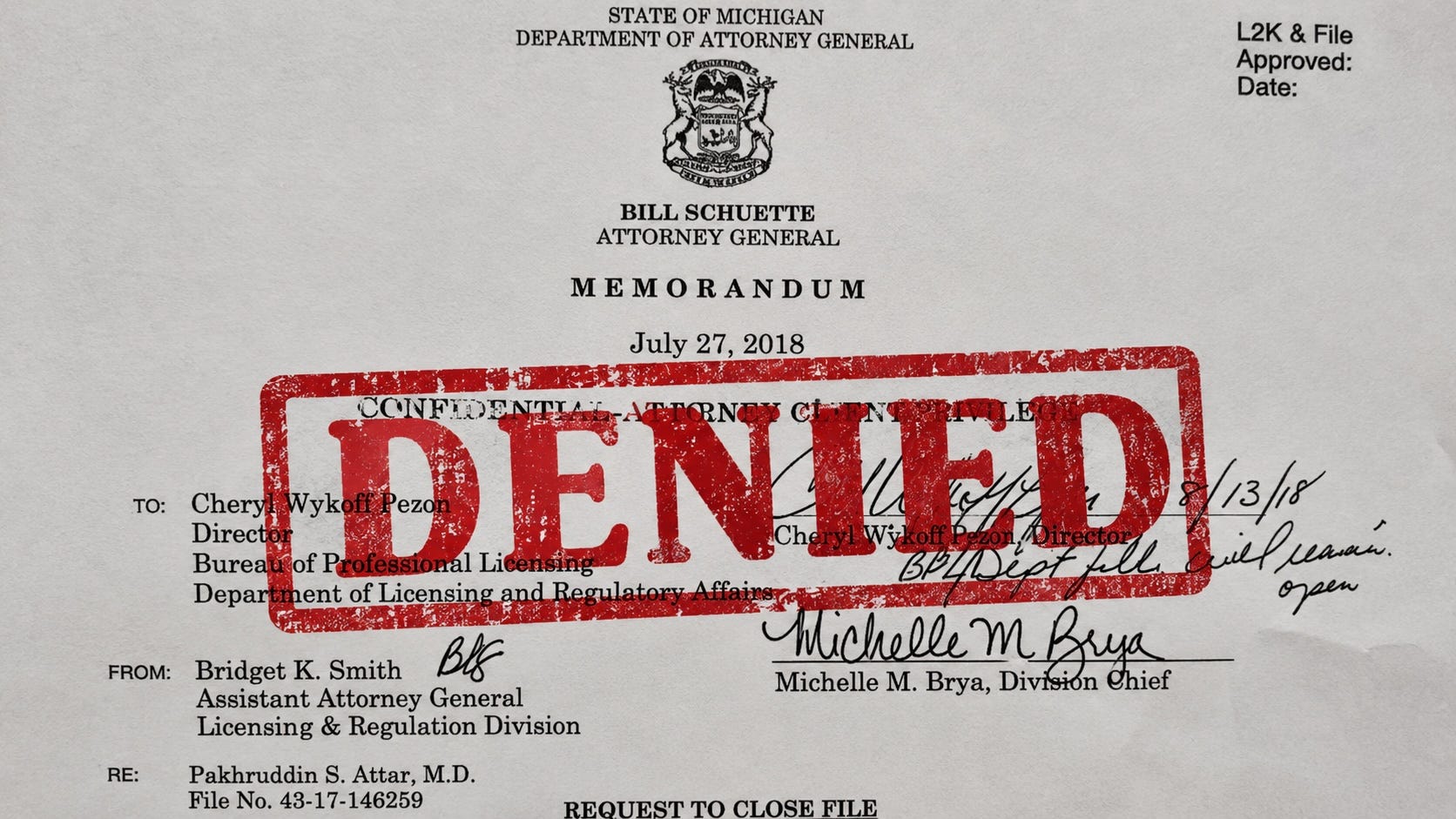
Two state agencies denied appeals to release the memo that closed Michigan’s only licensing investigation of a doctor federally indicted for performing female genital mutilation on children. They issued their denials on the same day. They used the same language.
The document at issue is a July 27, 2018 memorandum authored by Assistant Attorney General Bridget K. Smith, titled “Request to Close File.” It recommended that the Bureau of Professional Licensing end its investigation of Dr. Jumana Nagarwala without disciplinary action. A redacted version exists in the state’s files. Every word of substance has been blacked out.
As previously reported, the investigation closed on September 25, 2018, two months before the federal prosecution was dismissed. No licensing discipline resulted. Dr. Nagarwala holds an active, unrestricted Michigan medical license. LARA renewed it through June 2029 this past April, in seven minutes, with no screening of her complaint history. Dr. Fakhruddin Attar, the clinic owner charged alongside her, also holds an active, unrestricted license through March 2027. His clinic has reopened at a new location in Farmington Hills. Both physicians now also practice together at Livernois Primary and Urgent Care in Detroit.
The closure memo is the only document that explains why.


On May 1, 2026, I appealed to LARA, the licensing agency that received the memo and closed the investigation. The appeal argued that Michigan’s FOIA statute requires agencies to separate privileged legal analysis from factual content and release the non-privileged portions. It cited the AG’s own privilege log, which revealed two versions of the memo sent to two different bureau directors, neither previously disclosed by LARA.
On May 2, I filed a parallel appeal to the Attorney General, the agency whose lawyer wrote it. That appeal made four arguments: that the statute requires segregation of exempt and non-exempt material, that the AG’s role in this case was investigative rather than purely advisory, that factual content is not automatically privileged because an attorney wrote it, and that privilege may have been waived through disclosures to federal prosecutors.
Both agencies denied the appeals on May 18, 2026.
LARA’s denial, signed by Appeals Officer Adam Sandoval, did not address the segregation argument. It did not address the two-version discrepancy. It did not address LARA’s independent authority to waive privilege as the client. It offered one paragraph of analysis: the memo “fall[s] squarely within this privilege, and redactions made were appropriate.”
The AG’s denial, signed by Division Chief Eric Jamison of the State Operations Division, did not address the segregation argument. It did not address the waiver question. It did not address the AG’s mixed investigative role. It accused the requester of having “neglected to mention” that privilege covers an attorney’s factual materials.
My appeal had stated: “Even if portions of the memorandum contain privileged legal analysis, the AG has not justified withholding the document in its entirety.” This statement directly addresses the point their denial claims I “neglected to mention.”
Both denials share a distinctive feature. Sandoval’s response refers to the filing as one “which has been characterized as an ‘appeal.’” Jamison’s response refers to the filing as one “which you identify as an ‘appeal.’” Both place the word appeal in quotation marks. Both use distancing language to suggest the filings were not, in their view, actually appeals.
This is the same rhetorical construction, scare quotes around the same word, applied through the same syntactic structure, appearing in official legal determinations from two different agencies, signed by two different officials, on the same day.
The AG’s Licensing and Regulation Division is the common thread. AAG Smith authored the closure memo. Her division would have been consulted before LARA could rule on whether to release a communication from its own attorney. The parallel language in the denials is consistent with both responses having been shaped by the same legal position, if not the same drafter.
However, the scare quotes and editorializing in the response raised a question: Was what I sent them an appeal or merely “characterized” as an appeal? Because, if it was not an appeal, I still had a legal right to file one.
On May 24, I asked both agencies whether their May 18 responses constituted final determinations under MCL 15.240. I asked why the responses used language distinguishing the filings from appeals, and whether I was entitled to file one.
LARA’s FOIA Office responded on May 26 and confirmed the filing was an appeal and their response a final determination and I could not file another appeal. They did not explain why Sandoval’s written denial characterized that same filing as something other than an appeal when LARA says it treated it as one.
The Attorney General did not respond. I sent a follow-up on June 6. The AG did not respond to that either. Since the AG would not confirm whether they considered my first appeal an actual appeal or its May 18 response was a final determination, I filed a second appeal on June 8.
My second appeal restated the four original arguments, documented that the AG’s May 18 response had not addressed any of them, and proved that the “neglected to mention” claim was wrong by quoting the passage from the first appeal that directly argued the point. It asked the AG to address each argument individually, to identify any arguments it was declining to address, and to explicitly state whether its response constituted a final determination.
On June 12, the AG responded. The response is seven pages. It is signed by FOIA Coordinator Christy Wendling-Richards, not by Division Chief Jamison, who signed the May 18 denial.
The first five pages reproduce the text of the June 8 appeal. Page six reproduces the May 18 Jamison denial, word for word. Page seven adds a referral to the Michigan State Bar’s lawyer referral service, where a $25 fee will connect the requester with an attorney for a 25-minute consultation.
The AG did not address the segregation argument. It did not address the mixed investigative role argument. It did not address the privilege waiver argument. It did not address the request for particularized justification. It did not identify which arguments it was declining to address. It did not state whether the response was a final determination.
The letter does contain one structural change. The May 18 denial referred to “your May 2, 2026 email, which you identify as an ‘appeal.’” The June 12 response refers to “your May 2, 2026 appeal.” The scare quotes are gone. The AG now calls it an appeal, while reproducing a denial that treated it as something less than one.
The June 12 letter also contains a particular arrangement. Pages two through five include the passage from the second appeal proving that the first appeal argued the very point the AG claimed it “neglected to mention.” Page six reproduces the “neglected to mention” claim. The AG placed the refutation and the claim it refutes in the same document, in sequence, and issued both as its official position.
The closure memo remains sealed. The public has no way to know why the state continues to license physicians federally prosecuted for FGM and their response to attempts to disclose their reasoning indicate they will not address arguments for disclosure unless a court compels them to.
A Court of Claims lawsuit could unseal the memo. If you’d like to support legal action, contribute here: Expose Medical Board for Licensing an FGM Doctor
Les Médecins pratiquant les M.G.F. pas sans raison, sauf addiction a les masturbations et fait dans la stupide volonté qui ne connais pas la limite de quoi peut ou peut pas être enlever. Grand nombre des cas n’enlève pas seul le gland qui supprime l'orgasmes pour les obtenir par les massages du col de l'utérus et point G. Et prostate chez les hommes circoncis du prépuce sans risque d'addictions et guérison d'addictions H & F pour éliminer les frustration homme et femme en manque de partenaire.
Why? They always say, "follow the money".
$$$$$$