

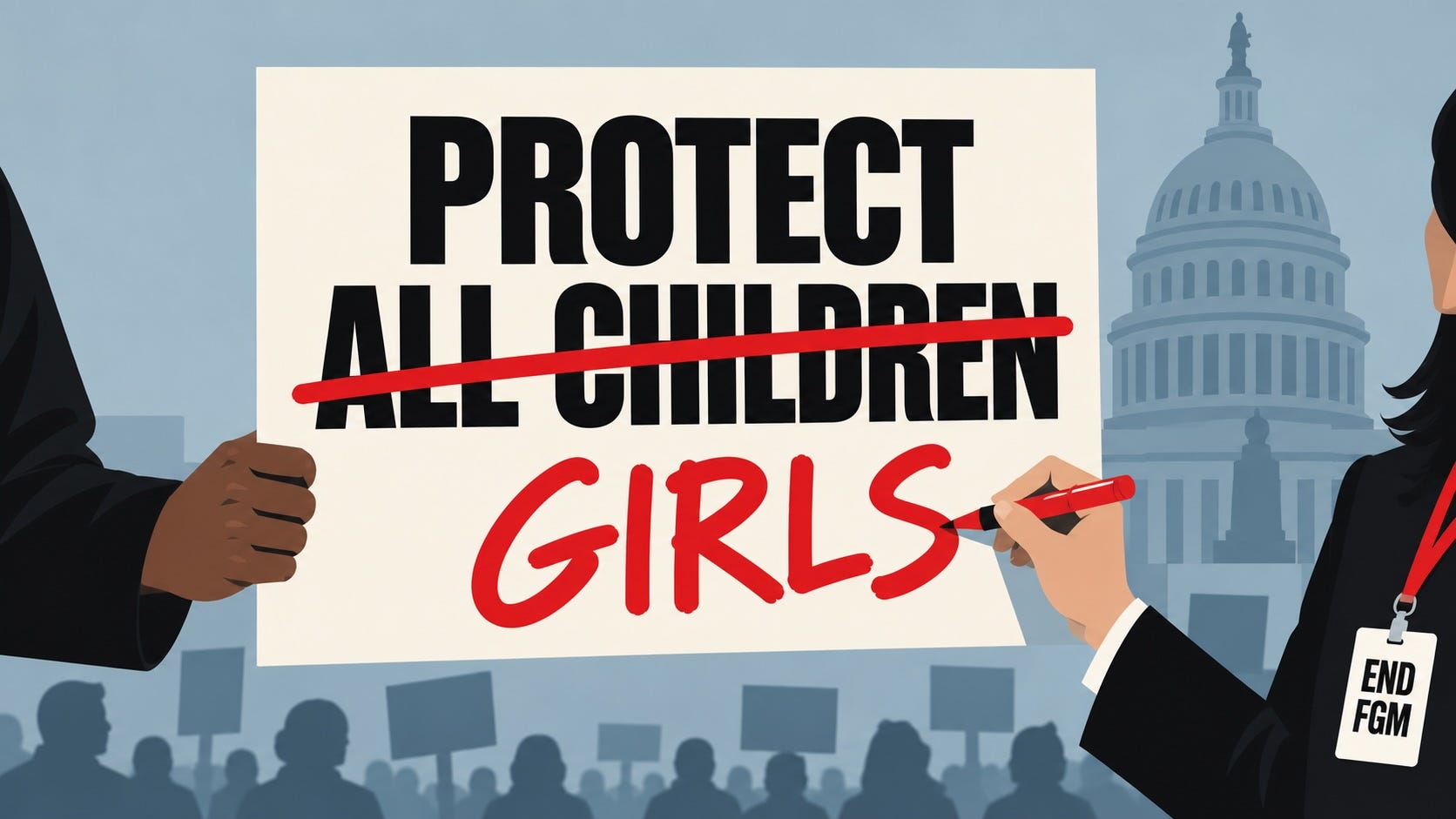
For years, intactivist and genital autonomy groups have wondered why anti-FGM organizations have not joined them in opposing all genital cutting, rather than just harm done to one gender.
Both movements oppose cutting the genitals of those who cannot consent. Both movements support the principle of gender equality. Given those principles, it follows that opposing one form of forced genital cutting requires opposing the other. Yet anti-FGM groups have drawn a clear distinction between male and female genital cutting. Why?
After researching and following the money, I believe I have an answer.
Summary: Anti-FGM organizations made a strategic decision to exclude male genital cutting from their mission. That decision allowed them to receive funding from governments and medical foundations that support male circumcision. Now, they are captured by those interests and effectively controlled opposition. The strategy intended to allow them to protect girls at the expense of boys made it so they cannot protect either.
Intactivists Have Opposed FGM/C
Intactivists and genital autonomy organizations oppose medically unnecessary genital cutting of all children, including FGM/C:
The National Organization of Circumcision Information Resource Centers adopted a declaration at its first international symposium in 1989 that asserted a right to an intact body and expressly named the foreskin, clitoris, and labia.
NOCIRC’s Fall 1993 newsletter was devoted to FGM. It promoted Soraya Miré’s documentary Fire Eyes, advertised educational material treating female and male genital cutting together, and directed readers to anti-FGM organizations including FORWARD and the Washington Metro Alliance Against Female Genital Mutilation.
NOCIRC’s Third International Symposium in 1994 screened Fire Eyes with Miré participating in discussion and included a dedicated FGM track covering medical ethics, eradication strategies, U.S. policy, and prosecution.
The International Coalition for Genital Integrity, founded in 1999, was an umbrella for approximately eighteen organizations addressing genital cutting of children regardless of sex.
Intact America gave Soraya Miré, the Somali filmmaker and FGM survivor, its Award for Personal Courage in 2009. In 2010 it opposed the American Academy of Pediatrics’ proposal to permit a ritual nick on girls.
Attorneys for the Rights of the Child applies a child-rights framework to genital cutting of girls, boys, and intersex children.
The Worldwide Day of Genital Autonomy, held annually since 2013, calls for protection of every child from non-therapeutic genital alteration. Its platform names FGM alongside male circumcision and intersex surgery.
Genital Autonomy submitted written evidence to the UK Parliament’s 2014 inquiry into FGM, supporting protection for girls while arguing it should extend to all children.
Despite Intactivist and genital autonomy organizations opposing female genital cutting, anti-FGM organizations have not reciprocated their support.
Anti-FGM Organizations Have NOT Opposed MGM/C
None of the anti-FGM organizations I contacted has opposed male genital cutting or infant circumcision the way they oppose female genital cutting:
AHA Foundation calls the analogy with male circumcision “blatantly off-base.”
A senior Equality Now representative told ABC News the practices were not the same at all. Equality Now has presented the comparison as an argument used by defenders of FGM.
The FGM/C Research Initiative, hosted by Orchid Project, rejects the terminology “female circumcision” because the implied parallel is said to obscure FGM’s seriousness.
End FGM European Network has stated explicitly that it has no position on male circumcision.
Sahiyo’s FAQ recognizes consent-related overlap and published a universal-consent guest essay in January 2026, but attached a disclaimer that the essay did not necessarily represent the organization.
No public position on male circumcision was found for Safe Hands for Girls, U.S. End FGM/C Network, or Tahirih Justice Center.
However, it wasn’t always this way.
Anti-FGM Founders Once Stood With Intactivists
The founders of the anti-FGM movement once shared the stage with intactivists:
Fran Hosken, author of The Hosken Report, presented “Female Genital Mutilation: Strategies for Eradication” at the first intactivist symposium in March 1989.
Hanny Lightfoot-Klein, author of Prisoners of Ritual, presented on FGM at NOCIRC’s 1994 and 1996 symposia. Her 1989 book on FGM included a chapter on protecting boys from circumcision, as ARC’s Oregon brief notes.
Nahid Toubia, who founded the anti-FGM organization RAINBO in 1994, gave the keynote address at NOCIRC’s 1998 symposium at Oxford. Her paper was titled “Evolutionary Cultural Ethics and Circumcision of Children.”
Soraya Miré, asked on The Oprah Winfrey Show in 1995 whether the sex of the child should matter, is quoted as saying: “Cut is cut.” She also appeared in my documentary American Circumcision opposing male genital cutting.
Comfort Momoh, a leading British FGM specialist, presented at NOCIRC’s 2008 Keele symposium, became joint patron of Genital Autonomy at its launch that year, and was listed as a speaker again in 2016.
Efua Dorkenoo, who founded FORWARD in 1983 and is remembered as the mother of the movement to end FGM, sat on a panel with Steven Svoboda of Attorneys for the Rights of the Child at the Royal Society of Medicine on July 4, 2008.
It is worth noting that these individuals, not organizations.
Why if the founders of the anti-FGM movement understood the parallels between male and female genital cutting, did anti-FGM organizations not oppose male circumcision?
Dorkenoo explained why.
Anti-FGM Organizations Strategic Decision
On July 4, 2008, the Royal Society of Medicine in London hosted a conference called “Genital Cutting in a Globalized Age” that included people working against FGM, male circumcision, intersex surgery, and cosmetic genital surgery.
Steven Svoboda, founder of the intactivist organization Attorneys for the Rights of the Child, gave a talk on the harm, law, and ethics of male circumcision.
Efua Dorkenoo spoke after him. She had founded FORWARD, Britain’s leading anti-FGM organization, and would go on to run Equality Now’s anti-FGM program.
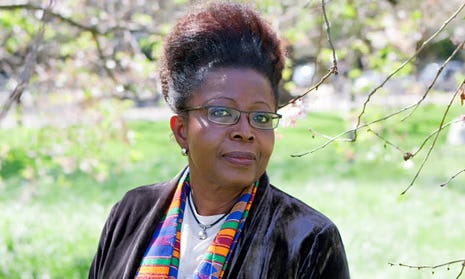
According to ARC’s report on the conference, Dorkenoo told the audience she wholeheartedly supported intactivism. The anti-FGM movement, ARC wrote, had simply made “a strategic decision not to work to protect males,” because protecting them would make its work harder.
That is ARC’s account of her remarks, not a transcript. Dorkenoo died in 2014. But it comes from someone who was on the panel with her, and nothing the anti-FGM movement has done since contradicts it.
In other words: the anti-FGM movement made a strategic choice to ignore male genital cutting.
What The Strategy Bought
By ignoring male circumcision, the anti-FGM movement achieved money and power. Here is a timeline of what followed Dorkenoo’s speech:
2008: UNFPA and UNICEF launched the Joint Programme on FGM, which they describe as the largest global programme on the issue.
2009: Amnesty International launched the END FGM European Campaign. Human Dignity Foundation was its sole funder.
March 2013: The UK government announced £35 million to end FGM in a generation. The UK’s aid watchdog called it the largest single donor investment ever targeted at FGM.
February 2014: The UK government appointed a consortium to run the campaign. Equality Now and FORWARD were members. It was led by Efua Dorkenoo of Equality Now.
2014: The End FGM European Network was founded out of the Amnesty campaign. It now receives approximately 96% of its revenue from the European Commission.
2020: Congress passed the STOP FGM Act. The Department of Justice made its first FGM-specific grants, including over $1 million to a technical-assistance provider partnered with the U.S. End FGM/C Network.
Six years after Dorkenoo told intactivists that leaving boys out was strategic, she was running the largest government-funded FGM campaign in history.
From one perspective, the strategy worked. The anti-FGM movement achieved money and power by ignoring the suffering of men and male children.
However, if we follow the money, there is another narrative: pro-circumcision medical and government organizations bought the anti-FGM movement.
Pro-Circumcision Groups Bought The Anti-FGM Movement
The funders of anti-FGM organizations are pro-circumcision.
Government: The same U.S. government that funds these organizations through Department of Justice grants has supported 35.1 million circumcisions through PEPFAR since WHO and UNAIDS recommended male circumcision in 2007, putting nearly $2 billion into it over the next decade. Medicaid covers routine newborn circumcision in 33 states. The State Department ran a coordinated campaign against circumcision bans in European countries. Congress wrote prohibitions on male circumcision bans into the Wolf Act as religious-freedom violations the State Department must monitor.
Bill & Melinda Gates Foundation gave Equality Now $8,297,470 across multiple grants, including a $1 million grant in September 2024. The same foundation has committed approximately $252 million across 44 grants to male circumcision programs. Those grants funded Population Services International to circumcise nearly 650,000 men in two countries, the Johns Hopkins randomized trial in Uganda, Weill Cornell Medical College to test a circumcision device on infants, and the University of Manitoba to introduce early-infant circumcision in Kenya.
Human Dignity Foundation financed the creation of the End FGM European Network through an approximately €2.2 million grant to Amnesty International. HDF was founded by Dr. John Climax, co-founder of ICON, a major clinical-research company.
Morris and Alma Schapiro Fund gave $250,000 to Safe Hands for Girls and separately funds Memorial Sloan Kettering Cancer Center ($550,000) and the Prostate Cancer Foundation ($400,000).
Oak Foundation funds the broader anti-FGM movement’s infrastructure through the Five Foundation and separately funded a Botswana HIV trial that included expanded access to circumcision services.
Novo Nordisk Foundation gave $650,000 to the UNFPA-UNICEF Joint Programme on FGM. Novo Nordisk Foundation is an enterprise foundation centered on medical science and biotechnology.
Children’s Investment Fund Foundation participates in the HER Africa Funder Alliance, a funder collaborative created by the Five Foundation to finance African anti-FGM organizations. CIFF’s portfolio includes global health programs across the same institutional networks.
I have documented these conflicts organization by organization in these articles:
Do Anti-FGM Organizations Have a Financial Conflict of Interest?

Anti-FGM organizations receive money from the government. They also receive private funding from foundations with ties to the medical system. The licensing of two FGM doctors sits at the intersection of both funding streams. Pursuing it means criticizing both a government medical board and the professional infrastructure their own donors finance. This i…
Is the Anti-FGM Movement a Government Sock-Puppet?

Anti-FGM organizations receive government funding. They act when activism means supporting government prosecution. They are silent when it means criticizing the government. Is the anti-FGM movement a government sock-puppet?
While the strategic decision to take money from pro-circumcision groups might have increased the wealth of the anti-FGM movement, what did this cost them?
What The Strategy Cost
Taking pro-circumcision money from government and medical interests made it so anti-FGM organizations cannot oppose female genital cutting when doing so means opposing the state and those financial interests and must support male genital cutting when the state and their financial interests demand it.
Two ways that is currently manifesting:
Anti-FGM organizations will not say FGM doctors should lose their licenses. Dr. Jumana Nagarwala and Dr. Fakhruddin Attar, the physicians charged in America’s first federal FGM prosecution, hold active medical licenses in Michigan today. On July 25, I emailed Equality Now, the U.S. End FGM/C Network, and Sahiyo asking whether physicians who perform FGM on children should hold medical licenses. None of them answered. A medical licensing board is a government agency. Criticizing its decision means criticizing the government while depending on the government for operating revenue.
Those same anti-FGM organizations will go to court to keep boys out of a genital cutting law. On July 23, two days before ignoring those emails, the same three organizations asked an Oregon court to reject a lawsuit brought by three men challenging the state’s FGM statutes as sex discrimination. Their brief argues that including male circumcision would “needlessly and negatively impact” the work to end FGM. Extending the law takes nothing from girls. But it would challenge the medical system their donors finance.
Read about these two issues here:
Are Anti-FGM Organizations Fine With Licensing FGM Doctors?

I asked eight organizations that work to end female genital mutilation whether two physicians charged in America’s first federal FGM prosecution should continue to hold active medical licenses. Six did not respond. One responded, but did not answer the questions. One initially took a position that meant that FGM doctors should keep their licenses, and h…
Anti-FGM Groups Protect Male Circumcision While Ignoring FGM Licensing

Three anti-FGM groups went to court in Oregon with two law firms to oppose a circumcision lawsuit, but none of them will answer an email about the ongoing medical licensing of FGM doctors.a
Dorkenoo's strategy was presented as a sort of triage: Protect girls first, because that fight can be won. Come back and save the boys later.
However, that strategy is only defensible if:
Girls are actually protected.
The movement eventually returns to the issue of male genital cutting with their newfound resources and support.
Instead, the strategy sacrificed both their core mission of ending female genital cutting and the issue of male genital cutting.
Anti-FGM organizations are now ignoring the licensing medical doctors who performed female genital cutting while filing legal briefs against male circumcision lawsuits. As a strategy to end female genital cutting, it failed. As a strategy to make money, it succeeded.
In other words, the movement sold out.
The Pro-Circumcision Strategy
Consider this from the perspective of pro-circumcision organizations. There is a growing movement against all genital cutting. What is your best strategy to stop them?
You could fight the genital autonomy movement directly, but that draws attention to them and the comparison between male and female genital cutting. A better strategy would be to divide them and fund a controlled opposition movement — one that appears to be against “genital cutting” but never actually threatens your money, power, and institutional connections.
Whether or not it was a conscious strategy, this is what pro-circumcision organizations did to the tune of millions of dollars. They funded organizations that opposed female genital cutting with a narrative that excluded male genital cutting, and gave them access to law firms, government contracts, UN partnerships, and media attention.
From this perspective, the $8.3 million the Gates Foundation gave Equality Now is not a grant to end FGM. It is the cost of ensuring that the world’s most prominent anti-genital-cutting organizations will never threaten the $252 million circumcision portfolio. The DOJ grants to Sahiyo are not the cost of ending FGM in the Dawoodi Bohra community. They are the cost of making sure the organization founded by that community’s survivors will not say that a doctor who cut their girls should lose her license.
What pro-circumcision organizations are buying is a credible voice against genital cutting that draws the line exactly where they need it drawn to protect their interests. Now anyone who argues that cutting a boy is the same as cutting a girl is not arguing against pro-circumcision organizations, but anti-FGM organizations. The movement that should be their biggest threat is on their payroll and doing their work for them.
How Anti-FGM Narrative Supports Male Genital Cutting
Anti-FGM organizations have framed the issue of genital cutting as exclusively as violence against women and girls, creating a narrative that prevents acknowledging the ways male children are harmed and makes cooperation with genital autonomy organizations impossible:
The joint amicus brief filed by Equality Now, Sahiyo, Safe Hands for Girls, and WeSpeakOut in the Nagarwala case presents FGM as a violation of girls’ and women’s rights, not children’s rights. The framework itself excludes boys.
AHA Foundation’s terminology article argues the comparison with male circumcision is used to diminish FGM’s seriousness. An AHA-hosted advocate profile describes raising male circumcision in FGM-law discussions as “a distraction.”
Equality Now’s coverage of the 2026 Indian Supreme Court hearing presents the comparison with male circumcision as an argument made by defenders of the practice. Comparing FGM to circumcision is cast as defending FGM, not as defending children.
The World Health Organization said in 1996 that FGM could not be likened to male circumcision. UNFPA says the term “mutilation” helps establish a clear distinction from male circumcision. The U.S. Office on Women’s Health states directly that FGM is not the same as male circumcision. These institutional positions provide the authoritative language anti-FGM organizations invoke when resisting a universal genital-autonomy frame.
Political scientist Charli Carpenter analyzed how advocacy networks treat male circumcision as a “lost cause.” She found that linking the issue to FGM triggered gatekeeping concerns: competition for attention, confusion of the anti-FGM message, conflict with the women’s-rights framing, and fear of weakening a successful campaign.
When GAMS Belgium organized a 2019 expert meeting examining FGM in relation to male genital cutting, the invitation generated negative reactions from partners within the anti-FGM network itself. Some feared that opening the comparison meant weakening opposition to FGM.
In July 2026, Equality Now, the U.S. End FGM/C Network, and Sahiyo went to court in Oregon to oppose a lawsuit challenging the state's FGM statutes as sex discrimination. Their brief claims that FGM is rooted in gender-based violence and the control of women’s sexuality, has no medical benefits, and causes severe lifelong harm, while male circumcision does not.
The pro-circumcision strategy worked. There is now a large movement against “genital cutting” that ignored the most prolific form of genital cutting and excludes real opposition to their interests.
Are Anti-FGM Organizations Controlled Opposition?
Political scientists have a term for what happens when funders redirect a social movement’s agenda: movement capture. Megan Ming Francis coined it to describe how the Garland Fund used its money to shift the NAACP from fighting lynching to fighting school segregation. The funder didn’t oppose the NAACP. It supported it, on the condition that it pursue the funder’s priority rather than its own.
A 2025 paper on controlled opposition in democracies takes this further. It argues that in liberal democracies, controlled opposition no longer requires spies or informants. It runs on NGO funding dependencies and what the author calls “performative dissent”: organizations that look like opposition, hold the credentials of opposition, and never threaten the interests of the people paying them.
The anti-FGM movement fits this definition. Its organizations receive funding from governments and foundations that support male circumcision. They have adopted a narrative that treats any comparison between male and female genital cutting as an attack on their mission. They show up in court to defend FGM laws from being extended to boys but will not answer an email about whether FGM doctors should keep their licenses. They produce laws, conferences, reports, and amicus briefs. They do not produce prosecutions, license revocations, or any outcome that would require confronting the government agencies and medical institutions that fund them.
Whether this is controlled opposition depends on how you define the term. If it requires a conscious conspiracy, some secret meeting in a room where a nefarious cabal decided to buy a movement, I’m not sure there is one. Each groups appears to be acting on their interests. Pro-circumcision medical and government groups want to fund organizations that won’t oppose circumcision. Anti-FGM groups want mainstream support and funding. Everyone wins — except for the children. This appears to be the result of systems, not conspiracy. However, the result is the same as if there was conspiracy.
The anti-FGM movement occupies the space where a real genital autonomy movement should stand. It holds media contacts, UN partnerships, and legal budgets, but uses those to oppose efforts against genital cutting and ignore the licensing of FGM doctors. Whether or not anyone consciously asked them to this, this is exactly what anti-FGM organizations would do if they were controlled opposition.
For years, intactivists have wondered why anti-FGM groups will not work with them. The answer is that they were built to never do that.