

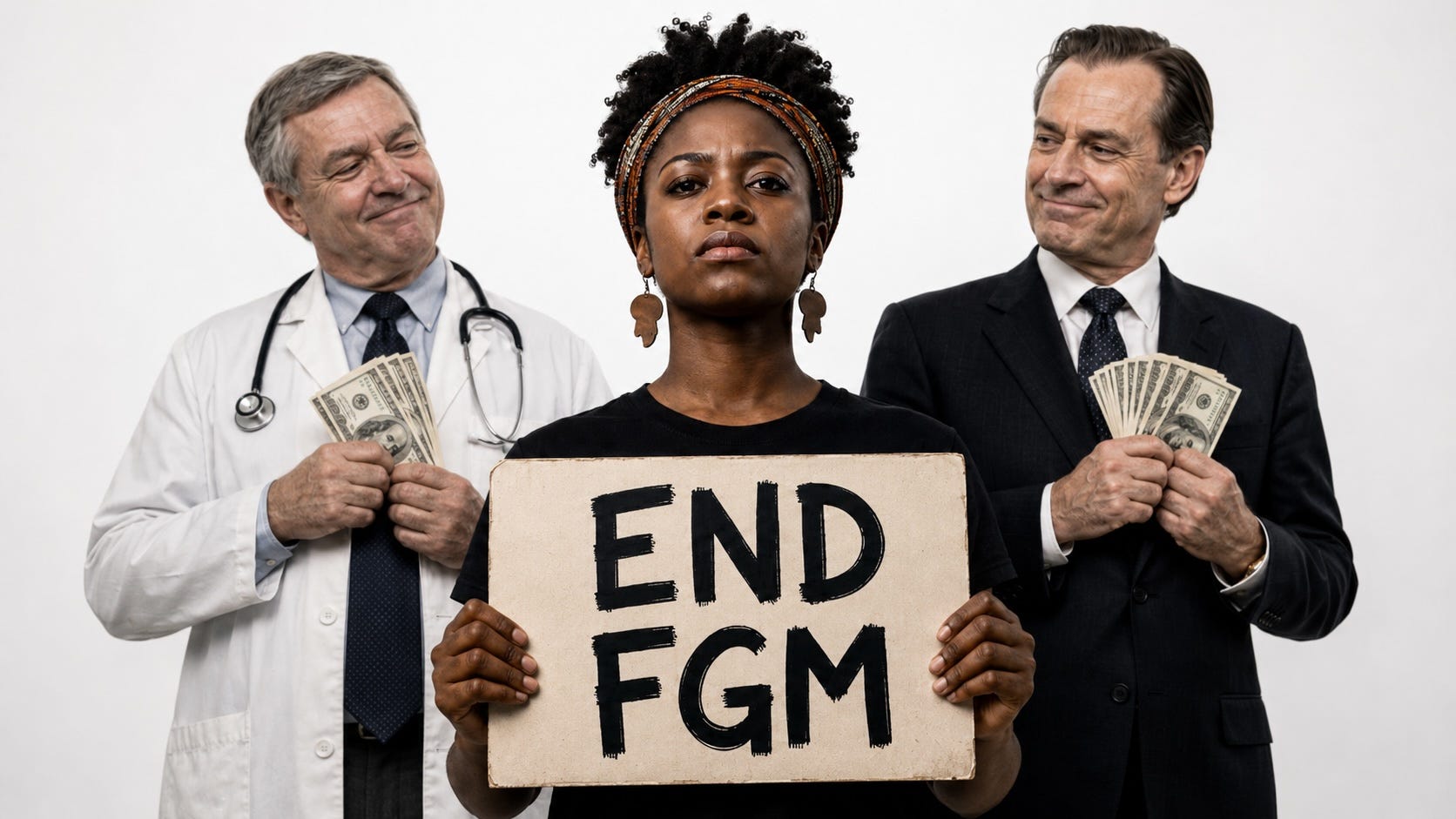
Anti-FGM organizations receive money from the government. They also receive private funding from foundations with ties to the medical system. The licensing of two FGM doctors sits at the intersection of both funding streams. Pursuing it means criticizing both a government medical board and the professional infrastructure their own donors finance. This is a financial conflict of interest.
Context
Dr. Jumana Nagarwala and Dr. Fakhruddin Attar were charged in the first federal FGM prosecution in U.S. history. Both hold active, unrestricted Michigan medical licenses. Michigan’s Bureau of Professional Licensing closed investigations into both licenses before the federal prosecution ended. Memos explaining why their cases were closed have been withheld from the public.
I asked eight anti-FGM organizations whether the physicians should continue to hold active medical licenses. Six did not respond. One responded without answering the questions. One had to be told to read the reporting before it revised its position.
Full story on anti-FGM organizations response:
Are Anti-FGM Organizations Fine With Licensing FGM Doctors?

I asked eight organizations that work to end female genital mutilation whether two physicians charged in America’s first federal FGM prosecution should continue to hold active medical licenses. Six did not respond. One responded, but did not answer the questions. One initially took a position that meant that FGM doctors should keep their licenses, and h…
The Government Conflict
As I reported in “Is the Anti-FGM Movement a Government Sock-Puppet?,” anti-FGM organizations receive government money.
Government funding creates one conflict of interest: pursuing the licensing issue means criticizing a state government agency, and these organizations depend on government agencies for grants and contracts.
You can read that full article here:
Is the Anti-FGM Movement a Government Sock-Puppet?

Anti-FGM organizations receive government funding. They act when activism means supporting government prosecution. They are silent when it means criticizing the government. Is the anti-FGM movement a government sock-puppet?
However, government funding is only half the problem. The rest of the funding of anti-FGM organizations has ties to the medical system.
The Medical Conflict
I researched the fourteen largest private foundations funding the anti-FGM movement. Seven have ties to medicine, hospitals, biomedical research, pharmaceuticals, or public health as a central program area, a material grant category, or the source of the founding fortune.
Three are biomedical or global-health funders:
Bill & Melinda Gates Foundation gave Equality Now $8,297,470 across multiple grants, including a $1 million grant in September 2024. Gates is one of the world’s largest global-health and vaccination funders. It committed $1.9 billion to Global Health in 2024 and pledged $1.6 billion to Gavi in 2020 alone. It works through WHO, UNICEF, universities, pharmaceutical firms, and national public-health systems.
Children’s Investment Fund Foundation participates in the HER Africa Funder Alliance, a funder collaborative created by the Five Foundation to finance African anti-FGM organizations. CIFF’s health and nutrition portfolio includes HIV medication, reproductive health, maternal health, government health systems, and pharmaceutical-access programs.
Novo Nordisk Foundation gave $650,000 to the UNFPA-UNICEF Joint Programme on FGM. It is an enterprise foundation centered on medical science, biotechnology, and life-science research, and committed DKK 1.8 billion to its vaccine and immunity initiative.
Three make medical grants:
Oak Foundation gave $466,667 over three years to the Five Foundation, a coordinating body for anti-FGM funders. Its Special Interest Programme expressly includes medical research and healthcare projects.
Conrad N. Hilton Foundation participates in the HER Africa Funder Alliance. Its longstanding programs include multiple sclerosis, avoidable blindness, substance-use prevention, and children affected by HIV/AIDS.
Morris and Alma Schapiro Fund gave $250,000 to Safe Hands for Girls and separately funds Memorial Sloan Kettering Cancer Center ($550,000) and the Prostate Cancer Foundation ($400,000).
One was built on a medical-industry fortune:
Human Dignity Foundation financed the creation of the End FGM European Network through an approximately €2.2 million grant to Amnesty International. HDF was founded by Dr. John Climax, co-founder of ICON, a major clinical-research company that runs trials for pharmaceutical firms. Climax remains founder and chair, and the foundation’s board and staff draw partly from the pharmaceutical sector.
The largest private donors to anti-FGM organizations are embedded in the medical system. How has the medical system responded to licensing FGM doctors?
Medical Complicity
The medical system has not condemned licensing FGM doctors.
As I previously reported, the Federation of State Medical Boards did not say that physicians charged in a federal FGM prosecution should lose their medical licenses. The American Medical Association would not condemn licensing FGM doctors, and deferred to the Federation of State Medical Boards. No insurer would say that FGM doctors should be removed from their network.
No medical organization would say that FGM doctors should lose their licenses, including the American College of Physicians, American Academy of Pediatrics, American College of Obstetricians and Gynecologists, and American College of Emergency Physicians.
The anti-FGM organizations’ private donors are embedded in this medical infrastructure. Pushing a medical board to revoke a physician’s license means pushing against the professional system their funders finance and participate in. Anti-FGM organizations’ response mirrors the response of medical organizations.
Intersectional Conflict
The licensing issue sits at the intersection of both medical and government conflicts. Pursuing it would require anti-FGM organizations to act against the interests of both.
Every organization has at least one conflict:
Equality Now reported $500,054 in government grants in 2021 and received $8,297,470 from the Gates Foundation, one of the world’s largest global-health funders. Both conflicts.
End FGM European Network receives approximately 96% of its revenue from the European Commission and was created with an approximately €2.2 million grant from Human Dignity Foundation, whose founder co-founded ICON, a clinical-research company. Both conflicts.
Sahiyo reported 60.3% of its operating budget as government grants, including DOJ and HHS funding. Government conflict.
Tahirih Justice Center reported $5,552,673 in government grants in 2024, approximately 46.6% of revenue. Government conflict.
AHA Foundation reported $38,000 in government grants in 2024 and holds a $500,000 DOJ award. More than $2 million of its identified private funding came through donor-advised funds that do not disclose the underlying donors. Government conflict; private donors untraceable.
U.S. End FGM/C Network is a DOJ Office for Victims of Crime technical-assistance provider and participates in a $300,000 DOJ cooperative agreement. It is fiscally sponsored by Reading Room Cleveland and does not disclose its budget or donors. Government conflict; private donors undisclosed.
Orchid Project is a funded participant in a UK FCDO program on ending FGM; its share is not disclosed. Government conflict.
Safe Hands for Girls has no verified government funding. Its largest identified donor, the Schapiro Fund, gave $250,000 and separately funds Memorial Sloan Kettering and the Prostate Cancer Foundation. Medical conflict.
The licensing of FGM doctors requires opposing both at once. None did.
The Conflict
Anti-FGM organizations have a financial conflict of interest when it comes to opposing the licensing of FGM doctors.
The organizations with the budgets, the legal teams, the policy staff, and the stated mission to end female genital mutilation have not pursued the licensing of two physicians charged in the first federal FGM prosecution.
The licensing issue requires them to challenge a government medical board. Their government funders pay them to serve government agencies, not to criticize them. Their private donors are embedded in the medical system they would need to challenge.
While these organizations might care about FGM, does their funding allow them to act on it, when acting means challenging the institutions that fund them?
P.S. I do not have government funding or large private donors.
Keep up the pressure, Brendon. Very important work you are doing documenting the corruption, and the conflicts of interest.