

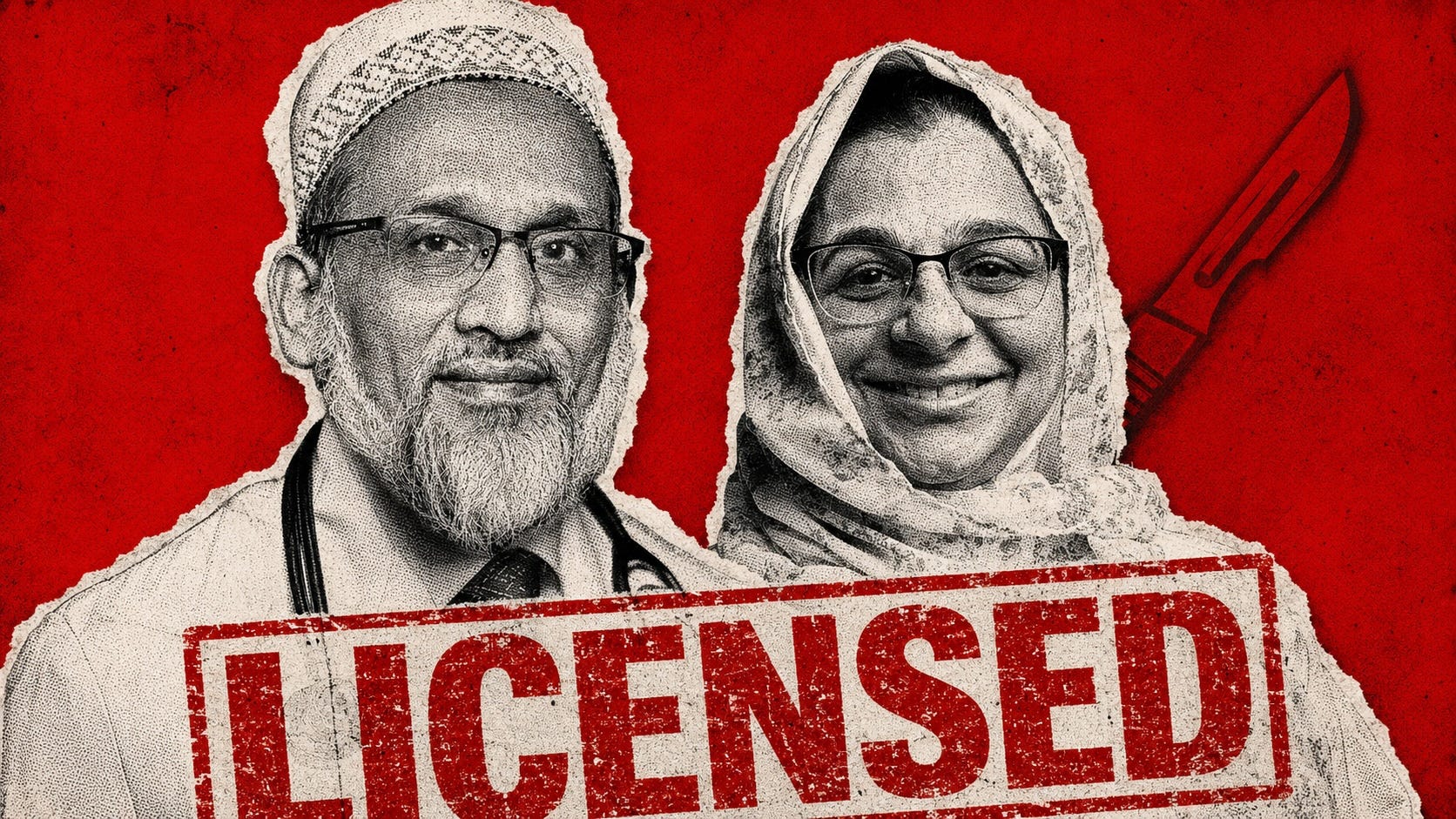
Dr. Jumana Nagarwala and Dr. Fakhruddin Attar were charged in 2017 in the first federal prosecution of female genital mutilation in United States history. Both hold active, unrestricted medical licenses issued by the State of Michigan. They now practice together at a Detroit clinic that advertises school physicals and accepts Medicaid.
Michigan’s licensing agency closed its investigation into Nagarwala on September 25, 2018, two months before the federal charges were dismissed. The Attorney General recommended closing Attar's case on July 27, 2018, four months before. State records certify that no traditional investigation was ever conducted into Attar. Both cases were closed with no disciplinary action.
Every fact in the timeline below is sourced to state licensing files, Attorney General records, internal agency communications, federal court documents, public record, or on-the-record statements. I obtained the non-public records through more than a hundred Freedom of Information Act requests.
Summary
Michigan's Board of Medicine unanimously authorized an investigation into Nagarwala and recommended emergency suspension for Attar.
The state never executed the suspension and never assigned an investigator to Attar’s case.
The only witness interview attempted in Nagarwala’s investigation was blocked by the federal prosecutor.
The Attorney General recommended closing both cases while the federal trial was still scheduled.
LARA told the press both investigations were “active” months after its own records show they were closed.
When a physician filed a new complaint in 2019, LARA dismissed it by citing a monitoring file with no investigative authority, saying nothing about the civil investigation it had already closed.
Every medical organization asked about the case — including the AMA, the AAP, and the Federation of State Medical Boards — declined to say that physicians who cut the genitals of children should lose their medical licenses.
The lead author of the AAP’s retracted 2010 ritual nick policy says it should never have been retracted.
The memos explaining why the state closed both investigations remain sealed.
Timeline
September 30, 1996 — Congress criminalizes FGM.
President Clinton signs the Illegal Immigration Reform and Immigrant Responsibility Act, which includes 18 U.S.C. § 116, making it a federal crime to circumcise, excise, or infibulate the genitalia of any female under 18. The maximum penalty is five years in prison. The law provides no exception for custom or ritual.
2001 — A law professor argues the federal FGM statute is constitutionally vulnerable.
Dena S. Davis publishes “Male and Female Genital Alteration: A Collision Course with the Law?” in Health Matrix at Case Western Reserve. Davis argues that the federal FGM statute is vulnerable because it bans all genital alteration on girls — “no matter how minimal the surgery or how safe and sanitary the procedure” — while leaving male circumcision untouched. Her recommendation: “Federal and state laws should be rewritten to allow the sort of minor genital nick.” The article calls the disparity “unacceptable on First Amendment grounds.”
April 26, 2010 — The American Academy of Pediatrics (AAP) proposes legalizing a “ritual nick” of girls genitals.
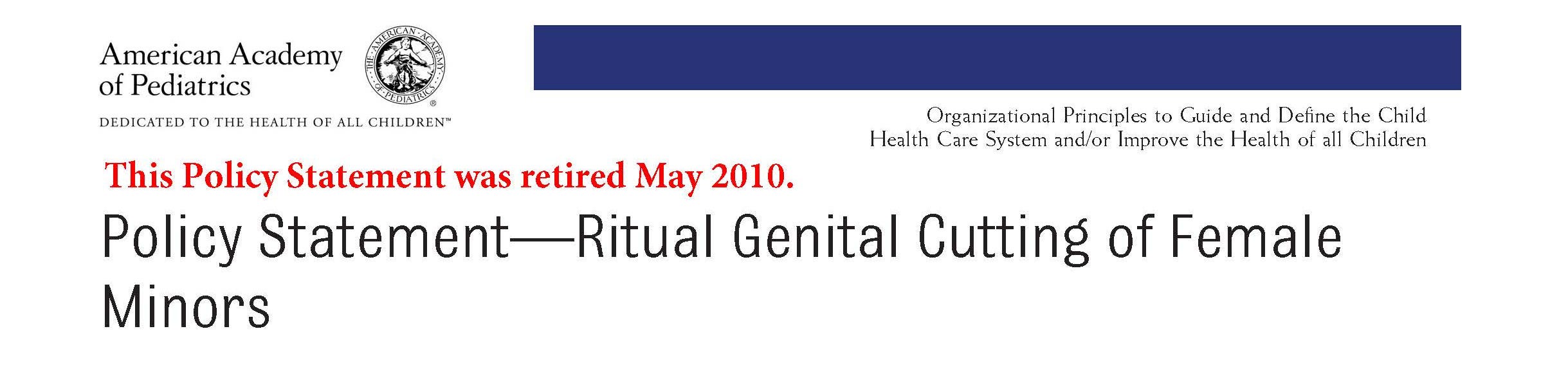
The AAP’s Committee on Bioethics publishes “Policy Statement—Ritual Genital Cutting of Female Minors“ in the journal Pediatrics. The lead author of the statement was Dena S. Davis, who cites the constitutional argument she published nine years earlier.
The statement suggests that since “some forms of FGC are less extensive than the newborn male circumcision” federal and state laws should be changed to “enable pediatricians to reach out to families by offering a ritual nick.” The AAP compares the nick to an ear piercing.
The statement is retracted in just twenty-six days due to public outcry. However, the retraction is not the result of its author changing her mind. Dena S. Davis, the author of the statement told me that she “does not think AAP should have retracted the policy statement--still don’t.”
The policy statement had revealed the medical establishment’s willingness to accommodate genital cutting on girls within a clinical framework. The retraction showed it could not do so publicly.
April 2017 — The first federal FGM case begins.
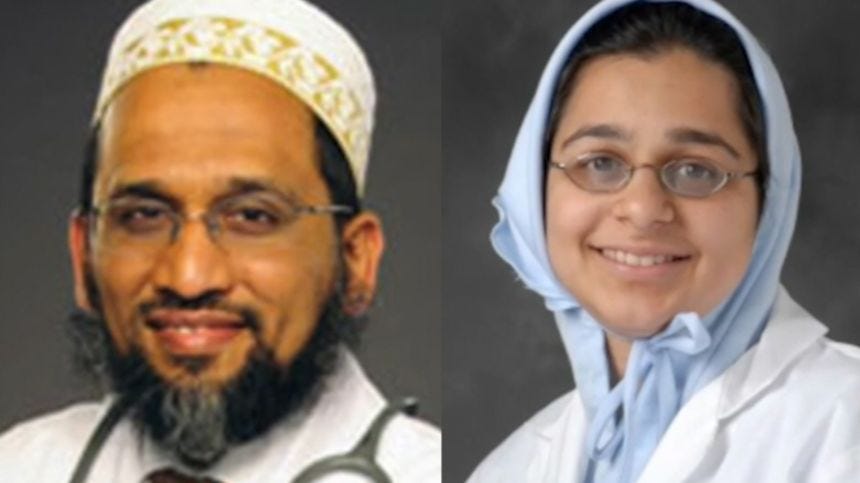
The FBI arrests Dr. Jumana Nagarwala, an emergency room physician, and charges her with performing female genital mutilation on young girls at a clinic in Livonia, Michigan. The clinic is owned by Dr. Fakhruddin Attar. His wife, Farida Attar, is charged with assisting during the procedures. Federal prosecutors call it the first federal FGM case in U.S. history, twenty-one years after Congress passed the law.
The FBI identifies nine victims between the ages of seven and thirteen from Michigan, Minnesota, and Illinois. One girl tells agents she had been told they were going to the doctor because “our tummies hurt.” When agents interview Attar, he acknowledges that Nagarwala treated girls ages six to nine at his clinic, that she came only after hours on Fridays and Saturdays, performed the procedures for free with no paperwork, and did so five or six times per year. Prosecutors estimate as many as 100 girls may have been cut at the clinic over a twelve-year period.
April 18, 2017 — Michigan’s Board of Medicine authorizes an investigation into Nagarwala.
Five board reviewers unanimously authorize an investigation into Nagarwala’s medical license (complaint file 43-XX-146153). The same day, a Michigan Department of Licensing and Regulatory Affairs (LARA) analyst opens a separate criminal monitoring file (#146169) to passively track the federal prosecution. Two files now exist on the same physician — one for the state’s own civil licensing investigation, one to monitor the federal case.
April 21, 2017 — The Board authorizes an investigation into Attar and recommends emergency suspension.
Board reviewer Dr. Peter Graham writes on Attar’s file (43-XX-146259): “I approve investigation. Please also refer to Director Gaedeke for summary suspension, which I approve.” Board reviewer Dr. James Sondheimer, a professor of medicine at Wayne State University, writes: “Agree with proceeding with investigation. Res ipsa loquitur” — a legal term meaning “the facts speak for themselves.”
The Michigan Department of Licensing and Regulatory Affairs (LARA) never executes the summary suspension. It never assigns an investigator to Attar’s case.
June 2017 — LARA takes “no position” on a bill to revoke FGM doctors’ licenses.
Senate Bill 410 would require permanent revocation of a health professional’s license upon conviction for female genital mutilation. LARA’s enrolled bill analysis records the agency’s official stance: “ADMINISTRATION POSITION: No position.”


The same document identifies the Nagarwala and Attar case by name. Internal emails show the decision was deliberate. On June 13, 2017, Marnie Wills, Deputy Director of LARA's Office of Policy and Legislative Affairs, wrote to colleagues: “I let her know we will have no position.”
July 11, 2017 — Governor Snyder signs Michigan’s anti-FGM laws.
Governor Rick Snyder signs a package of twelve bills criminalizing FGM under Michigan state law. The package increases the maximum penalty to fifteen years in prison — triple the federal penalty. It requires automatic license revocation upon conviction. It makes parental consent no defense. It makes custom or ritual no defense. Michigan becomes the twenty-sixth state to ban FGM.
The bill passes the Michigan House 105-2 and the Senate 38-0. LARA uses neither the authority it told the legislature it already had, nor the new authority the legislature provided.
September 29, 2017 — The federal prosecutor blocks the state’s only witness interview.
LARA investigator Jennifer Pappas contacts Dr. Dena Nazer, a board-certified child abuse pediatrician at Kids TALK Medical Center whose job is evaluating children suspected of being maltreated. The interview has been requested by the Assistant Attorney General’s office itself. Nazer responds that she will forward the request to her attorneys.
Two days later, U.S. Assistant Attorney Sara Woodward, the lead federal prosecutor on the FGM case, calls Pappas directly. Woodward tells the state investigator that Nazer “will not be providing a statement to our Bureau due to the pending Federal Court Case and due to WITNESS NAZER’s limited knowledge about the licensee’s activities.”


Pappas submits her investigation report the same day. It documents no further investigative activity. The state never interviews another witness in the case. Ten months later, the Attorney General recommends closing the investigation.
July 27, 2018 — The Attorney General recommends closing the Attar investigation.
Assistant Attorney General Bridget K. Smith authors a “Request to Close File” memo for Attar’s case (43-XX-146259), addressed to Cheryl Wykoff Pezon, then Director of LARA’s Bureau of Professional Licensing. The substantive content is redacted in full. LARA receives the memo on August 7, 2018.


No investigation into Attar is ever conducted. LARA later confirms under FOIA: “A traditional investigation was not conducted under 43-XX-146259.” Michigan’s Board of Medicine authorized an investigation and recommended emergency suspension. No investigator was assigned. No suspension was executed. No hearing was held. The Attorney General closed a file the state never opened.
Smith authors a parallel closure memo for the Nagarwala investigation the same day. The federal case is still active. Trial is scheduled for January 2019. The state does not wait for it to conclude.
September 25, 2018 — LARA closes the Nagarwala investigation.
Two months after Smith recommended closure, LARA closes civil investigation file 43-XX-146153. The complaint history printout records the disposition: “No Action Taken.” The federal case will not be resolved for another two months.


Eight days earlier, LARA Division Director Jon Campbell emailed staff: “Please add this to the criminal file – 146169. It appears the investigative file is being closed until witnesses can testify on behalf of the department, thus, this is the only remaining file under the criminal charges.”
November 20, 2018 — A federal judge strikes down the FGM law.
U.S. District Judge Bernard A. Friedman rules that 18 U.S.C. § 116 — the federal FGM statute Congress passed in 1996 — is unconstitutional. In a 28-page opinion, Friedman writes that Congress “overstepped its bounds” and that FGM is “’local criminal activity’ which, in keeping with longstanding tradition and our federal system of government, is for the states to regulate, not Congress.”
The ruling dismisses the FGM charges against both physicians. It addresses the law, not the physicians’ conduct. No party in the case disputes that procedures were performed on the girls.
Friedman’s opinion includes this passage: “The government’s suggestion that ‘those seeking the procedure [can] travel to refuge states where the practice is not prohibited’ is simply false. No state offers refuge to those who harm children.”
Michigan closed its own investigations before this ruling. The Nagarwala investigation ended two months earlier. The Attar closure was recommended four months earlier. The collapse of the federal case did not cause the state’s inaction.
December 10, 2018 — LARA lies to the press by claiming both investigations are still active.
Medscape publishes an article reporting that both physicians’ licenses are “active but under investigation” and that LARA “could not comment further on active investigations.”
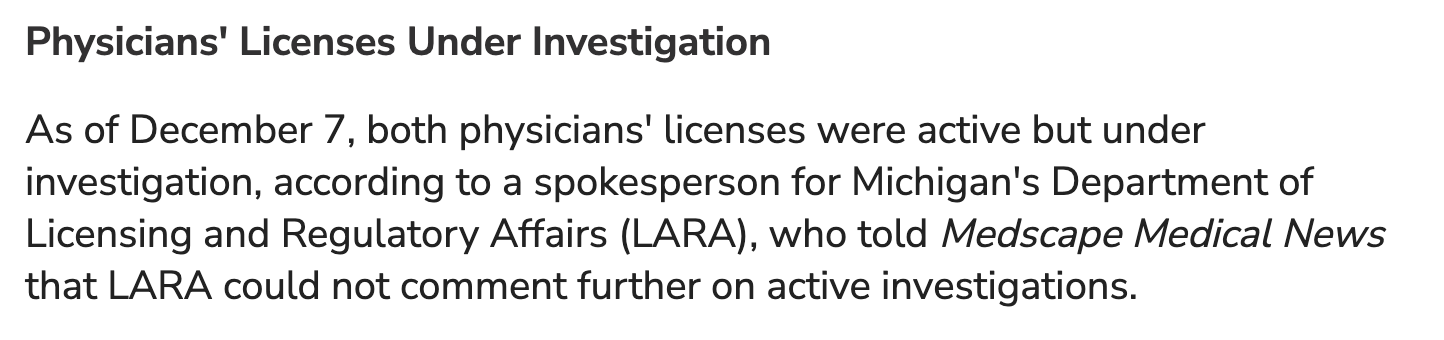
LARA’s own records show both investigations had been closed. The Nagarwala investigation closed months earlier with no action taken. No investigation into Attar was ever conducted. Internal LARA emails from December 5 show multiple senior officials — including BPL Director Pezon, Division Director Campbell, Cynthia Rowe, and Forrest Pasanski — coordinating the agency’s response to the Medscape inquiry.
2019 — The Department of Justice declines to appeal. It asks Congress to fix the law instead.
The DOJ does not appeal Judge Friedman’s ruling that the federal FGM statute is unconstitutional. In April 2019, the Department sends a letter to Congress asking lawmakers to amend 18 U.S.C. § 116 to add Commerce Clause language that would survive constitutional challenge. The government that brought the first FGM prosecution in American history declines to defend the law that made it possible.
Remaining charges in the case, conspiracy and obstruction, continue in Friedman’s courtroom.
June 22, 2019 — A physician files a complaint calling the cutting “torture.”
A board-certified anesthesiologist files licensing complaint COM19-001459 against Nagarwala. The complainant identifies themselves as a former Michigan physician with an active California medical license. They write that Nagarwala “has apparently performed over 100 surgeries without anesthesia, over the past 10 years” and say the practice “amounts to torture, for which we forbid on death row inmates.” They implore the Board of Medicine to “take action against this physician.”
The complainant knows the federal case has been dismissed. They are asking the state to use its independent authority to discipline the license.
February 5, 2020 — LARA dismisses the complaint by citing the wrong file.
LARA tells the physician their concerns are “being addressed” in file number COMxx-146169 — the criminal monitoring file, which has no investigative authority. The agency says nothing about civil investigation file 43-XX-146153, which was closed with “No Action Taken” seventeen months earlier.
The criminal monitoring file existed to passively track the federal case. The federal case was dismissed over a year before. LARA cited a file that could not investigate and said nothing about the file that already hadn’t.
After February 2020 — No state agency takes any further action on either physician’s license.
Michigan never holds a single administrative hearing. The Michigan Office of Administrative Hearings and Rules, the body that adjudicates physician disciplinary cases, has zero proceedings related to either physician on file. No investigator is ever assigned to Attar’s case.
January 5, 2021 — Congress passes the STOP FGM Act.
The Strengthening the Opposition to Female Genital Mutilation Act of 2020 (H.R. 6100) becomes law. It amends 18 U.S.C. § 116 to add Commerce Clause nexus language, increases the maximum penalty to ten years, and expands the scope of punishable acts. Section 5 includes a “sense of the Congress” that Judge Friedman’s ruling was wrong.
The law is a direct response to Friedman’s November 2018 decision and the DOJ’s April 2019 letter. It cannot be applied retroactively. Congress has fixed the statute, but the fix comes too late to prosecute the physicians whose case broke it.
August 2022 — Attar reopens his clinic under a nearly identical name at a new location.
The corporate entity that operated Burhani Medical Clinic at the Livonia address, the clinic where federal prosecutors said Nagarwala performed FGM on minor girls, dissolved in May 2021. The remaining federal charges were dismissed in September 2021.
Eleven months later, on August 29, 2022, the NPI record is updated to a new address: 32910 W 13 Mile Road in Farmington Hills. The practice keeps the same phone number. The authorized official on the federal provider registry is Farida Attar, who was charged alongside her husband as a co-defendant in the federal case.

The new clinic advertises sports physicals and care for patients of “every age group.” It accepts Medicare, Medicaid, and major commercial insurers. Private physician offices are exempt from facility licensing in Michigan. There was no facility license to revoke, no facility-level inspection triggered by the federal charges, and no regulatory mechanism to prevent the same practice from reopening under a nearly identical name. The only oversight ran through the individual physicians’ medical licenses, which the state never restricted.
September 28, 2021 — Judge Friedman dismisses the remaining charges for vindictive prosecution.
After having the FGM counts dismissed, and then successfully moving to dismiss charges under 18 U.S.C. § 2423 (transport of a minor for criminal sexual activity — a statute Friedman ruled had no reasonable application to FGM), the defendants face a fourth superseding indictment. The government files new conspiracy and witness tampering charges based on the same underlying conduct.
Friedman rules the prosecution vindictive. He writes that “the government obtained the fourth superseding indictment, which asserts new and additional charges, in retaliation for defendants’ past success in having other charges dismissed.” He notes that all remaining charges rely on FGM being a federal offense — which his own earlier ruling declared void ab initio, as if it had never been passed. He dismisses the fourth superseding indictment.
The case is over. No defendant is convicted. The federal system spent four and a half years prosecuting the case and has nothing to show for it. The state system spent eighteen months not investigating and has nothing to show for it either. The question of whether these physicians should hold medical licenses has never been adjudicated by anyone.
March 2022 — Both physicians are practicing together again, at a new clinic advertising services for children.


Nagarwala and Attar register a new practice, Livernois Primary and Urgent Care, at 18254 Livernois in Detroit’s University District neighborhood. The National Provider Identifier is registered on March 24, 2022. Nagarwala is the founder. Attar is staff. Neither physician’s biography on the clinic’s website mentions the federal prosecution.
The last time they worked out of the same clinic was Burhani Medical Center in Farmington Hills — where, according to the federal indictment, Nagarwala performed FGM procedures on minor girls while Attar opened his clinic after hours to let her do it.
The clinic’s services page advertises school physicals, sports physicals, camp physicals, and childhood immunizations — services marketed to children and their parents. Its Google listing identifies it as “women-owned,” “Asian-owned,” and “LGBTQ+ friendly.”


The clinic accepts thirteen insurance providers, at least seven of which are taxpayer-funded: Medicaid of Michigan, Medicare of Michigan, UnitedHealthcare Community Plan, Molina Healthcare, Meridian Health Plan, Aetna Better Health of Michigan, and McLaren Medicaid.
May 17, 2025 — A patient files a complaint against Nagarwala.
A patient who is treated by Nagarwala in the emergency room at Garden City Hospital in Westland, Michigan files a licensing complaint alleging she improperly administered a drug injection following a car accident. The patient had no way of knowing who their doctor was. Nothing on Nagarwala’s public license record indicates her history.
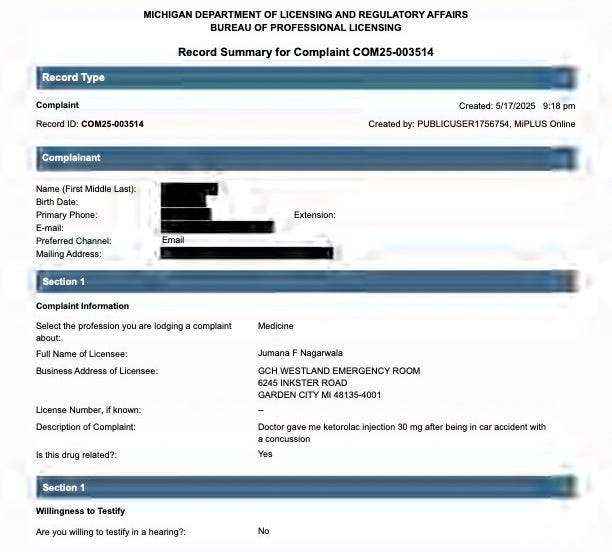
Garden City Hospital, asked to comment, calls Nagarwala “an independent physician” who “is not employed by Garden City Hospital.” The hospital characterizes the federal prosecution as a case that was “dismissed by the courts.” It declines to say whether it was aware of Nagarwala’s prosecution when she was credentialed.
Nagarwala, contacted directly, responds: “This is the first I have heard about this.” She does not respond to a follow-up invitation for a full interview.
April 14, 2026 — LARA renews Nagarwala’s license in seven minutes.
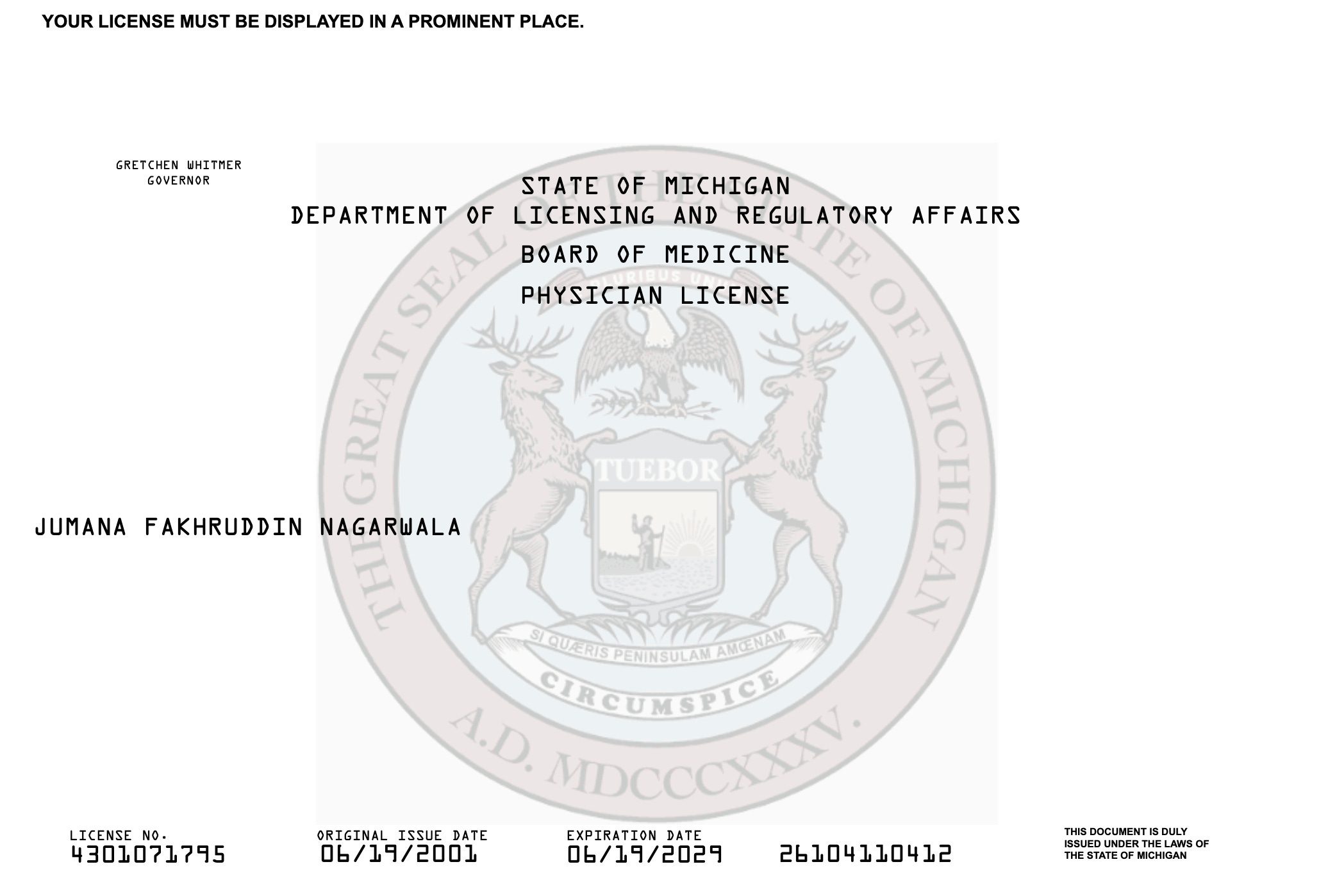
Nagarwala submits her renewal application at 12:53 PM. By 1:00 PM, the system emails her a confirmation. The FOIA production contains only what Nagarwala submitted and the automated system emails. No complaint history check. No compliance screening. No human review. No reference to the federal case or the cutting allegations anywhere in the renewal record.
The renewal form’s good moral character questions ask only about convictions, not charges, indictments, arrests, or investigations. Since the federal case was dismissed on constitutional grounds, Nagarwala was not required to disclose her history with the federal FGM prosecution or the cutting allegations.
Her license is renewed through June 19, 2029.
May 18, 2026 — Both agencies deny appeals to release the closure memos on the same day, using the same language.
LARA and the Attorney General’s office each deny FOIA appeals seeking the unredacted closure memos. LARA’s denial, signed by Appeals Officer Adam Sandoval, does not address the argument that the statute requires separating privileged legal analysis from releasable factual content. The AG’s denial, signed by Division Chief Eric Jamison, does not address it either. Neither addresses privilege waiver. Neither addresses the AG’s mixed investigative role.
Both responses contain the same construction. Sandoval refers to the filing as one “which has been characterized as an ‘appeal.’” Jamison refers to the filing as one “which you identify as an ‘appeal.’” Both place the word appeal in scare quotes. Both issued the same day.


The closure memos remain sealed.
June 1, 2026 — The Federation of State Medical Boards declines to condemn licensing physicians who perform genital cutting on children.
The Federation of State Medical Boards (FSMB), the national organization representing every state medical board in the country, is asked whether physicians who performed genital cutting on children should retain active medical licenses.
It responds that it “does not license or discipline individual physicians and is not involved in any decisions about investigations or cases” and “cannot comment on the circumstances involving any particular physician.”
Several of the questions concern FSMB’s own policy positions, not specific physicians. A follow-up removes all case-specific questions and asks only about policy. The FSMB does not respond.
June 6, 2026 — The American Medical Association condemns FGM but defers to the organization that won’t.
The AMA is sent seven questions about the licensing of the Michigan physicians. R.J. Mills of AMA Media & Editorial responds the next day. He answers none of the seven questions.
He calls FGM “child abuse by any physician in the United States” but says the AMA “does not have an authorized role in the regulatory process run by the State of Michigan.”
He refers the inquiry to the Federation of State Medical Boards as “the national voice of the state-run regulatory system for medicine.” Five days earlier, the FSMB declined to condemn genital cutting on children and refused to comment on the case.
June 7, 2026 — No medical organization will say FGM doctors should lose their licenses.
Eleven medical organizations are contacted and asked whether physicians who perform genital cutting on children should retain medical licenses, including the American College of Physicians, the American Academy of Pediatrics, the American College of Obstetricians and Gynecologists, and the American College of Emergency Physicians.
The three that do — the FSMB, the AMA, and the Oakland County Medical Society — do not answer the question. None of the eleven says that female genital cutting on children should cost a physician their medical license.
June 19, 2026 — The lead author of the retracted AAP policy says it should never have been retracted.
Dena S. Davis, the lead author of the AAP’s 2010 ritual nick policy, states in an email that she opposes the retraction. “No, I did not think AAP should have retracted the policy statement,” Davis writes. “Still don’t.”

She adds that "the ritual nick is a good way to equalize male and female, but it would be even better, in my opinion, not to do it at all." Asked to clarify what she means by "equalize," she does not answer.
June 23, 2026 — The AAP does not answer questions about its physicians’ licensing.
Asked five questions about the retraction, Davis’s position, and the licensing of the Michigan physicians, the AAP answers none of them.
It sends its 2020 clinical report on FGM/C. The report does not mention Nagarwala, does not mention Attar, does not mention their continued licensing, and does not mention the absence of disciplinary action.
Asked directly whether the AAP believes physicians who performed FGM/C on children should lose their medical license, the AAP does not reply.
Douglas Diekema, who chaired the committee that published the 2010 policy and is listed as Committee on Bioethics liaison on the 2020 report, does not respond.
Never — A single instance of mandatory reporting.
Every state in the country requires physicians to report suspected child abuse. Physicians are mandatory reporters in Michigan under MCL 722.623, in Minnesota under Minn. Stat. § 626.556, in Illinois under 325 ILCS 5/4 — in all fifty states. The standard is not certainty. It is reasonable cause to suspect. Failure to report is a crime. In Michigan, it is a misdemeanor punishable by up to 93 days in jail.
Federal prosecutors estimated that as many as 100 girls were cut at Attar’s clinic over twelve years. The FBI identified nine victims between the ages of seven and thirteen from three states. One girl told agents she “got a shot” that “hurt really badly and she screamed.” After the procedure, she could barely walk and felt pain all the way down to her ankle. Her parents told her the procedure was “a secret” and that she was not supposed to talk about it. Those girls had other doctors in at least three states. If any of their physicians suspected or saw evidence of what had been done to them and did not report it, that physician committed a crime.
The Government Accountability Office reviewed federal efforts on FGM in 2016. It identified only a handful of U.S. investigations or prosecutions. It noted that healthcare providers may be mandatory reporters. It did not identify a single case that began with a physician’s report. Arkansas, one of the few states that formally tracks FGM reports by healthcare practitioners to its child abuse hotline, reported zero such reports for state fiscal year 2024.
Now — FGM doctors are a part of American medicine.
Michigan has never held a hearing on either physician’s license. The memos that would explain why remain withheld in full under attorney-client privilege. Both physicians practice together at a clinic that advertises school physicals for children and accepts Medicaid. One of those licenses was renewed in seven minutes.
Next — What could happen.
Before this investigation, the public had no access to the record. Through this investigation that has begun to change. No institution documented above has been required to answer for what these records show.
The Michigan legislature could hold oversight hearings. The House Oversight Committee has subpoena power over LARA. The officials who closed these investigations, told the press the cases were active months after their own records show they were closed, and dismissed a physician’s complaint by citing a file with no investigative authority can be compelled to testify under oath. No hearing has been held. The committee is chaired by Rep. Jay DeBoyer.
The Governor could act. LARA is an executive agency. It reports to the Governor. Every closure, every non-investigation, every lie to the press documented above happened within an agency the Governor directs. No Governor has addressed it. The Governor of Michigan is Gretchen Whitmer.
Federal agencies could review Medicaid provider enrollment. The clinic lists at least seven taxpayer-funded insurance programs. The Centers for Medicare and Medicaid Services has the authority to review whether physicians with documented FGM allegations should remain enrolled as Medicaid and Medicare providers. That review does not require a state disciplinary action that has never come, and it does not require LARA’s cooperation. The Secretary of Health and Human Services is Robert F. Kennedy Jr.
Courts could unseal the closure memos. The memos explaining why the Attorney General recommended closing both investigations — the only documents that would reveal the state’s reasoning — are withheld in full under attorney-client privilege. Lawyers I have spoken to have told me a legal challenge to those privilege claims would require a $10,000 retainer. The FOIA litigation and investigative reporting behind this article are funded here.
Victims could bring civil claims. The FBI identified nine victims between the ages of seven and thirteen from three states. Federal prosecutors estimated as many as a hundred girls were cut at the clinic over twelve years. No civil lawsuit has been filed. The statute of limitations for minors in Michigan does not begin to run until they turn eighteen.
Other states could investigate. The victims came from Michigan, Minnesota, and Illinois. Each state has its own medical board and its own mandatory reporting laws. Whether physicians in those states who treated the girls saw evidence and failed to report it is a question no one has asked.
Hospitals and insurers could act on their own. Every hospital that grants privileges and every insurer that contracts with these physicians has the independent authority to review that decision. They do not need LARA’s permission.
Michigan media could cover the licensing story they missed. Local outlets covered the federal arrests in 2017 and the constitutional ruling in 2018. The licensing failure — documented in state records obtained through FOIA — has not been covered. The Detroit Free Press, Bridge Michigan, the Detroit News, WDIV, and CBS Detroit all accept news tips.
National media could publish what’s already assembled. I assembled this timeline as a single independent journalist. The national press has not touched the case since the federal prosecution collapsed. I’ve already done the bulk of the work for them. The documentation is linked, sourced, and public. Fox News, ProPublica, NBC News, and the Washington Post accept tips.
International media could cover it through a different lens. International outlets do not share the same cultural and political issues that America has around genital cutting. They have no reason to avoid stories that document American institutional failure. In India, where the Dawoodi Bohra community at the center of this case is headquartered, journalists have covered this story for years. The BBC, Channel 4, and Sky News; the Times of India, The Wire, NDTV, The Caravan, and Al Jazeera all accept tips.
The story could spread through social media. Every media outlet listed above requires an editor to say yes. Social media does not. Media covers stories that are already trending. One way that could happen is if you share this article.
Nothing happens. Every institution and organization documented above failed to act. It is possible that either this investigation doesn’t reach those who can act or they do not act when they read it.
The unexpected happens. Something not on this list that no one predicted could happen. It depends who reads this and takes action.
Conclusion
Every failure documented above traces back to the issue that American law forbids genital cutting on girls and permits it on boys. As long as that disparity exists, no institution will be able to confront what happened in Michigan without confronting what happens in every hospital across the country. Holding physicians accountable for female genital cutting will require creating the systems necessary to end male genital cutting. Rather than confront that, they have chosen to permit female genital cutting through non-enforcement.
Support my investigation here.
Thank you for everything you’ve done to organize all this information. I’m outraged and just heart broken that nothing has been done to fix this horrible injustice to girls. I see that “doctor’s” Google page with all good reviews and it makes me sick. I thought there were some medical reasons for male circumcision, whereas none exist for FGM. It seems like your research suggests this is the reason why the powers that be do nothing. But it makes no sense to me. Ugh.